Sunday, November 28, 2021

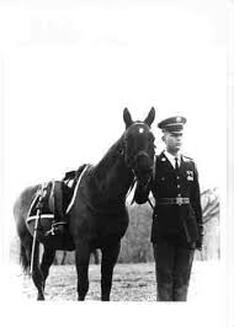
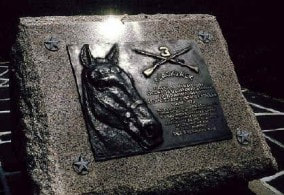
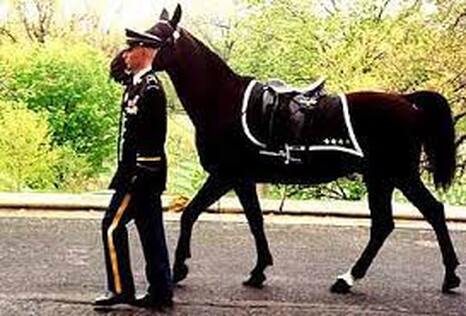
Horses in History: Black Jack


Wednesday, November 24, 2021

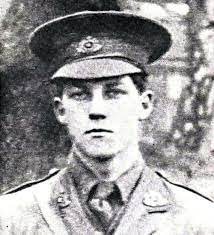
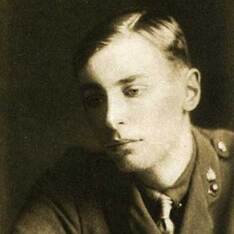
Herbert Read: World War I Poet


Picture
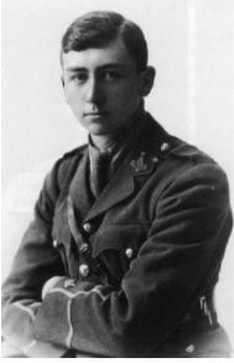
Herbert Read was unlike many of the young, privileged Englishmen who left university to prove themselves in the bloody cauldron of war. Born in Yorkshire, he was the eldest child of a tenant farmer who died when he was still young. Because they didn’t own the farm, the family had to leave. Read was sent to a school for orphans. His mother took a job managing a laundry. 
Read considered studying medicine after graduation. As a way to pay for it, he joined the local unit of the Royal Army Medical Corps and received a commission in the Green Howards, a Yorkshire Regiment. By the time he entered the University of Leeds, he’d decided that medicine wasn’t for him, so he transferred from the Medical Corps to the Officer Training Corps, where he found himself surrounded by men who had come through Eton or other public schools. Compared to them, Read felt provincial.
When the War broke out, Read left his studies and was shipped overseas.  He found that he was far more comfortable dealing with the sixty or so men in his platoon than the other officers. His platoon was filled with men who had done hard work in the mines and factories of Durham and North Yorkshire. Many were older and more experienced than he, who became a captain in his early twenties, but he developed a good repoire with them.  His fellow officers struck him as “snobbish and intolerant.”
He soon realized that “all the proud pretensions which men had acquired from a conventional environment” became insignificant at the front, and his fatalistic soldiers with their “Every bullet has it billet. What’s the use of worryin’?” attitude coped better than “men of mere brute strength, the footballers and school captains.”
Politically, Herbert Read was what the English call a “Quietist Anarchist.” He was no waver of flags and felt no fervor for one people over another. He expressed hope that the relationships that he had developed in the trenches would lead to new social movement after the war, and that class conflict and nationalities would be abandoned for a more egalitarian, universal social order. He saw signs that the world had wearied of war and was ready to put aside nationalism in this remembrance:


In April, 1918, when on a daylight ‘contact’ patrol with two of my men, we suddenly confronted, round some mound or excavation, a German patrol of the same strength. We were perhaps twenty yards from each other, fully visible. I waved a weary hand, as if to say: What is the use of killing each other? The German officer seemed to understand, and both parties turned and made their way back to their own trenches. Reprehensible conduct, no doubt, but in April, 1918, the war-weariness of the infantry was stronger than its pugnacity, on both sides of the line 
However, when the end finally came, Read found that he had lost too much to sustain much hope. His youngest brother, who had followed him into the Green Howards and had served on the Italian Front, died of a bullet shot in the last few months of war, leaving him in a state of grief that allowed no sympathy or consolation. Others, he knew, felt similarly. “We left the war as we entered it: dazed, indifferent, incapable of any creative action. We had acquired only one new quality: exhaustion.” 
When the Armistice came, a month later, I had no feelings, except possibly of self-congratulation. By then I had been sent to dreary barracks on the outskirts of Canterbury. There were misty fields around us, and perhaps a pealing bell to celebrate our victory. But my heart was numb and my mind dismayed: I turned to the fields and walked away from all human contacts.
Read, who earned both the Distinguished Service Order and the Military Cross, wrote two volumes of poetry based upon his war experiences: Songs of Chaos (1915) and Naked Warriors (1919). His poems are seen as a bridge between the lyrical forms used by Owen, Sassoon, and Graves and the epic form used by David Jones in In Parenthesis.  His poem, Kneeshaw goes to War, which I have included here, tells the story of one soldier who finds his personal meaning through, or in spite of, the horrific experiences he endured during the war. 
Picture
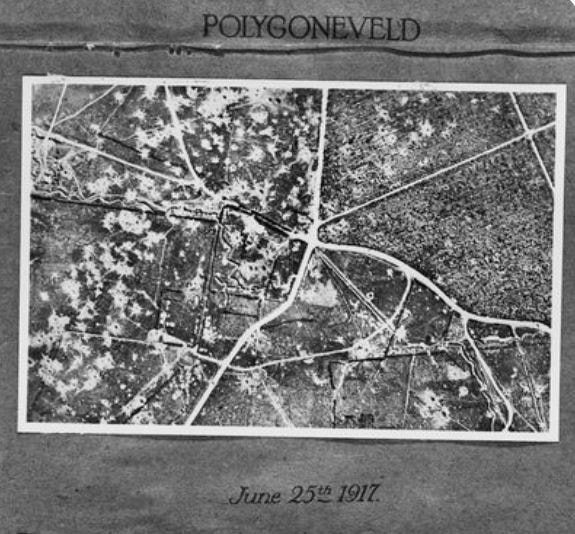
Aerial view of the Polygonveld (Polygon Wood) 25 June 1917. The town of Zonnebeke shelled to annihilation during WWI.

Kneeshaw goes to War

1

Ernest Kneeshaw grew
In the forest of his dreams
Like a woodland flower whose anaemic petals
Need the sun.

Life was a far perspective
Of high black columns
Flanking, arching and encircling him.
He never, even vaguely, tried to pierce
The gloom about him,
But was content to contemplate
His finger-nails and wrinkled boots.

He might at least have perceived
A sexual atmosphere;
But even when his body burned and urged
Like the buds and roots around him,
Abash'd by the will-less promptings of his flesh,
He continued to contemplate his feet.

2

Kneeshaw went to war.
On bleak moors and among harsh fellows
They set about with much painstaking
To straighten his drooping back:

But still his mind reflected things
Like a cold steel mirror — emotionless;
Yet in reflecting he became accomplish'd
And, to some extent,
Divested of ancestral gloom.
Then Kneeshaw crossed the sea.
At Boulogne
He cast a backward glance across the harbours
And saw there a forest of assembled masts and rigging.
Like the sweep from a releas'd dam,
His thoughts flooded unfamiliar paths:

This forest was congregated
From various climates and strange seas:
Hadn't each ship some separate memory
Of sunlit scenes or arduous waters?
Didn't each bring in the high glamour
Of conquering force?
Wasn't the forest-gloom of their assembly
A body built of living cells,
Of personalities and experiences
— A witness of heroism
Co-existent with man?

And that dark forest of his youth --
Couldn't he liberate the black columns
Flanking, arching, encircling him with dread?
Couldn't he let them spread from his vision like a fleet
Taking the open sea,
Disintegrating into light and colour and the fragrance of winds?
And perhaps in some thought they would return
Laden with strange merchandise --
And with the passing thought
Pass unregretted into far horizons.

These were Kneeshaw's musings
Whilst he yet dwelt in the romantic fringes.

3

Then, with many other men,
He was transported in a cattle-truck
To the scene of war.
For a while chance was kind
Save for an inevitable
Searing of the mind.
But later Kneeshaw's war
Became intense.
The ghastly desolation
Sank into men's hearts and turned them black --
Cankered them with horror.
Kneeshaw felt himself
A cog in some great evil engine,
Unwilling, but revolv'd tempestuously
By unseen springs.
He plunged with listless mind
Into the black horror.

4

There are a few left who will find it hard to forget
Polygonveld.
The earth was scarr'd and broken
By torrents of plunging shells;
Then wash'd and sodden with autumnal rains.
And Polygonbeke
(Perhaps a rippling stream
In the days of Kneeshaw's gloom)
Spread itself like a fatal quicksand, --
A sucking, clutching death.
They had to be across the beke
And in their line before dawn.
A man who was marching by Kneeshaw's side
Hesitated in the middle of the mud,
And slowly sank, weighted down by equipment and arms.
He cried for help;
Rifles were stretched to him;
He clutched and they tugged,
But slowly he sank.
His terror grew --
Grew visibly when the viscous ooze
Reached his neck.
And there he seemed to stick,
Sinking no more.
They could not dig him out --
The oozing mud would flow back again.

The dawn was very near.

An officer shot him through the head:
Not a neat job — the revolver
Was too close.

5

Then the dawn came, silver on the wet brown earth.

Kneeshaw found himself in the second wave:
The unseen springs revolved the cog
Through all the mutations of that storm of death.
He started when he heard them cry " Dig in!"
He had to think and couldn't for a while.
Then he seized a pick from the nearest man
And clawed passionately upon the churned earth.
With satisfaction his pick
Cleft the skull of a buried man.
Kneeshaw tugged the clinging pick,
Saw its burden and shrieked.

For a second or two he was impotent
Vainly trying to recover his will, but his senses prevailing.

Then mercifully
A hot blast and riotous detonation
Hurled his mangled body
Into the beautiful peace of coma.

6

There came a day when Kneeshaw,
Minus a leg, on crutches,
Stalked the woods and hills of his native land.
And on the hills he would sing this war-song:

The forest gloom breaks:
The wild black masts
Seaward sweep on adventurous ways:
I grip my crutches and keep
A lonely view.

I stand on this hill and accept
The pleasure my flesh dictates
I count not kisses nor take
Too serious a view of tobacco.

Judas no doubt was right
In a mental sort of way:
For he betrayed another and so
With purpose was self-justified.
But I delivered my body to fear --
I was a bloodier fool than he.

I stand on this hill and accept
The flowers at my feet and the deep
Beauty of the still tarn:
Chance that gave me a crutch and a view
Gave me these.

The soul is not a dogmatic affair
Like manliness, colour, and light;
But these essentials there be:
To speak truth and so rule oneself
That other folk may rede.


Picture
Jennifer Bohnhoff used to teach high school and middle school English, and she often included a unit on the World War I poets. She has now retired and writes from the quietness of her own mountain home. He most recent book, A Blaze of Poppies, is about the experience of two New Mexicans during the Great War.

Sunday, November 21, 2021

The Pony Express


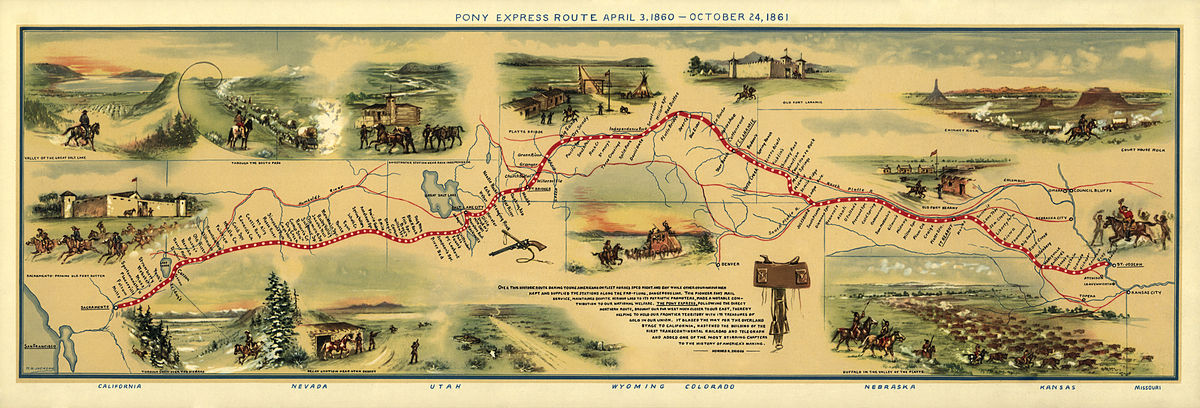
The Pony Express looms large in the lore of the American West, especially when one considers how short-lived it was. The Express, which was operated by Central Overland California and Pikes Peak Express Company, began delivering messages, newspapers, and mail on April 3, 1860. It was the quickest mode of delivering messages, and could get a letter from the Atlantic coast to the Pacific in about 10 days. By October 1861, the completion of the transcontinental telegraph had made the service obsolete.

The approximately 1,900-mile-long route for the Pony Express began at St. Joseph, Missouri, the far west terminus of the telegraph line. It roughly followed the Oregon and California Trails to Wyoming’s Fort Bridger, then followed the Mormon Trail to Salt Lake City, Utah. After that, it went to Carson City, Nevada Territory on the Central Nevada Route, then passed over the Sierra Nevadas before it reached Sacramento, California. From there, the mail went downriver by boat to San Francisco.  About 186 stations were set up about 10 miles apart along the route. Riders changed to a fresh horse each station. They rode night and day, stopping after 75–100 miles. In emergencies, and when the next rider was unavailable, riders might ride two stages back-to-back, spending over 20 hours on horseback. Some of the stations had bunkhouses in which the riders could sleep. 
Picture

The Pony Express Riders were all quite young, between 14 and 19 years old. They could not weigh over 125 pounds. At a time when unskilled laborers made between $0.43–$1 per day and bricklayers and carpenters could earn $2 per day, the riders received $125 a month, plus bonuses for fast completion of a route or for extraordinary dangers. The horses they rode were small, averaging 14.2 hands and 900 pounds, so while not strictly ponies, the name was appropriate.  

One of the most famous Pony Express deliveries was done by Robert Haslam, who later went by the nickname “Pony Bob.” Haslam was born in London, England in 1840. In April 1861, he rode 13 mustangs on an eight hour ride that took him through 120 miles of Nevada Territory. His route went through hostile Paiute Indian country. According to his journal, he engaged in a “running fight” with warring braves that lasted for “three or four miles.” During that fight, a flint-tipped arrow pierced his arm and another broke his jaw and knocked out five teeth. Haslam was able to escape after shooting the horses out from under several of the Paiutes. 


Haslam’s ride was part of a record-breaking delivery. While it usually took 10 days, this trip was completed in seven days, 17 hours. The delivery included Abraham Lincoln’s inaugural address, which helped the new state decide whether to stay within the Union or side with the Confederacy in the upcoming Civil War.

In recognition of his rapid and dangerous ride, the Express Company awarded Haslam $100. Although not delivering the packet might have changed the outcome of the war, Haslam was unfazed. He said, “ It’s nothing to get all fussed about. I’m a Pony Express rider. It’s all part of the job.”
When the Pony Express stopped, Pony Bob became and express rider for Wells, Fargo & Company.  As the Pacific Railway and telegraph lines pushed westward, he took other routes in increasingly remote areas. When there were no more express routes, he moved to Chicago, where he died, destitute, in 1912. His tombstone was paid for by long-time friend and fellow pony express rider, William “Buffalo Bill” Cody. 


Jennifer Bohnhoff writes historical fiction for readers in middle school through adult. She learns a lot from her readers, and would like to thank Owen Currier for sharing the story of Pony Bob Haslam that was the inspiration for this blog. 

Wednesday, November 17, 2021

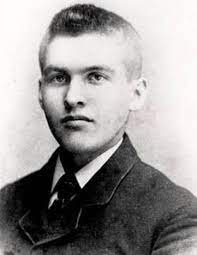
Charles Hamilton Sorley, World War I Poet


Picture
Charles Hamilton Sorley was born on May 19, 1895 in Aberdeen, Scotland. His father was a professor of moral philosophy. The family moved to Cambridge when Sorley was five.  He attended King’s College choir school and, like fellow WWI poet Siegfried Sassoon, Marlborough College, where he ran cross-country. Several of his pre-war poems are about running, especially in the rain.
 
Sorley received a scholarship to University College, Oxford. Before attending, however, he decided to spend sometime in Germany. He spent three months studying language and culture at Schwerin, then enrolled at the University of Jena. When Britain declared war on Germany, he was detained for a brief time, then told to leave the country.
 
Sorley returned to England and volunteered for military service. He joined the Suffolk Regiment, which arrived at the Western Front in May 1915. Sorley quickly rose from lieutenant to captain. On October 13, 1915 he was killed in action during the Battle of Loos by a sniper’s head shot. His last poem, “When You See Millions of the Mouthless Dead” was discovered in his kitbag after his death.

The first collection of Sorley’s poetry, titled Marlborough and other Poems, was published posthumously and went through six editions in the first year. Sorley’s deeply conflicted attitude about war is evident in his poetry and is likely due to his time in Germany.  was from its start. His poetry has been called ambivalent, ironic, and profound. In his autobiographical book Goodbye to All That, Robert Graves counted Sorley, along with Wilfred Owen and Isaac Rosenberg as “the three poets of importance killed during the war.” 

'When You See Millions of the Mouthless Dead'

Picture
When you see millions of the mouthless dead
Across your dreams in pale battalions go,
Say not soft things as other men have said,
That you'll remember. For you need not so.
Give them not praise. For, deaf, how should they know
It is not curses heaped on each gashed head?
Nor tears. Their blind eyes see not your tears flow.
Nor honour. It is easy to be dead.
Say only this, “They are dead.” Then add thereto,
“Yet many a better one has died before.”
Then, scanning all the o'ercrowded mass, should you
Perceive one face that you loved heretofore,
It is a spook. None wears the face you knew.
Great death has made all his for evermore.


Sunday, November 14, 2021

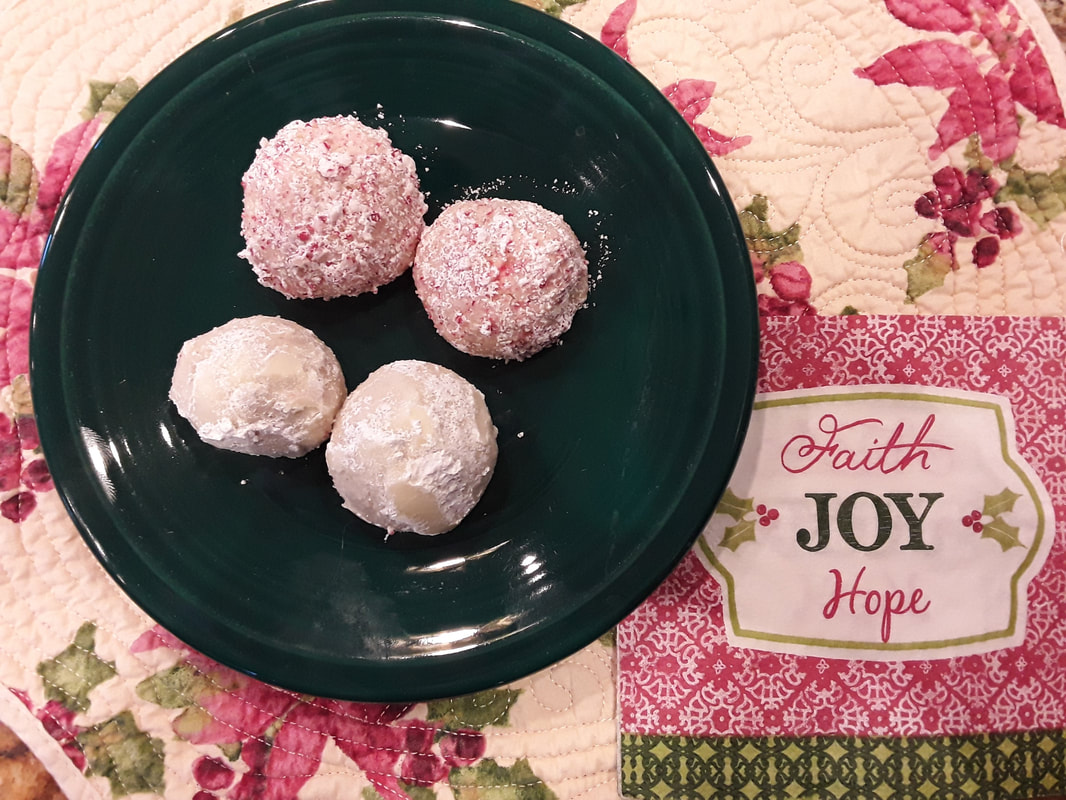
Two Variations on the Cookie with a Thousand Names


Picture
Okay, so a thousand names is a bit of hyperbole, but these are the cookies that everyone seems to call by a different name. I’ve heard these called Snowballs, Swedish Tea Cakes, Mexican Wedding Cookie, Russian Tea Cakes, and Butterballs, and I wouldn’t be surprised if you, dear readers, offered me an additional name or two.

Whatever you call them, these cookies have been a constant on the Bohnhoff Family Christmas cookie platter since long before I became a Bohnhoff. In our house, these cookies are made in balls, but I’ve seen them made into logs and crescents, too.

When my boys were young, I doubled this recipe every year. Sometimes I had to make it twice to make sure we had some all the way through the holidays. Then I discovered that one of my daughters-in-law was a peppermint fan, so I found and adaption that pleased her. It has now become a second standard on the cookie plate. The boys are all grown up, and the need for hundreds of cookies lying around the house has lessened, so I’ve adapted once again, to make two kinds of cookies from one batch of dough. I’m including suggestions so that you can make a full batch of regular butterballs, a full batch of peppermint butterballs, or one mixed batch. I’ve found the easiest way to make these is using a food processor. If you don’t have one, you’ll have to grind the nuts and peppermints in a blender, a coffeemill or some other way, then mix the ingredients in a mixer or by hand. However you pursue these, I hope you enjoy them!

Since Sweden, Mexico and Russia all get credit for these cookies, I am including a person from each who immigrated to America and significantly impacted our society. 


​Butterballs and Peppermint Butterballs

Preheat oven to 325°
If you are making half a batch of peppermint butterballs, whirr the following ingredients in a food processor until the candies are crushed fine, then set aside in a shallow bowl. Double the ingredients if you plan to make all your cookies peppermint.
1/3 cup confectioner’s sugar
1/3 cup broken peppermint candies or candy canes
 
If you are making half a batch of butterballs, place 1/3 cup powdered sugar in another bowl and set aside. Use ½ cup of powdered sugar if you are making a full batch of butterballs.
 
To make the dough for both cookies, process in food processor until chopped very fine
 
½ pecans (you can use almonds or walnuts if you prefer. It occurs to me that pinons would make a lovely New Mexican version of this cookie)
 
Add to food processor and pulse until mixed with the nuts.
 
½ cup powdered sugar
2 cups flour
¼ tsp salt
 
Add to ingredients in food processor and pulse until everything is blended into a dough that bunches together in a ball.
 
1 cup butter, softened to room temperature
1 tsp vanilla
 
Take dough out of food processor and knead on the counter a few times if you feel the butter hasn’t distributed all the way.
 
If you are making both variations of cookies, divide the dough in two.
 
To make butterballs, shape the dough into crescents, logs or balls about 1” large. Roll in the reserved bowl of powdered sugar.  Place 1 inch apart on ungreased cookie sheet. Bake at 325° for 15-20 minutes until set but not brown. Cool on a cooling rack, then roll again in powdered sugar.
 
To make filling for a half batch of peppermint butterballs, mix the following in a small bowl. Double ingredients if you are making a full batch
 
2 TBS peppermint and powdered sugar mixture
1 TBS cream cheese, softened
¼ cup powdered sugar
½ tsp milk
 
Put a tablespoon of dough into your hand and form into a ball. Use your thumb to make a pocket in the middle of the ball, and fill it with about ¼ tsp of the filling. Seal the ball shut and roll it in the peppermint and powdered sugar mixture. Place 1 inch apart on ungreased cookie sheet. Bake at 325° for 15-20 minutes until set but not brown. Cool on a cooling rack, then roll again in powdered sugar and crushed peppermints.

The Swede responsible for a famous American icon

Alexander Samuelson was born in Kareby parish, Kungälv, Bohuslän, Sweden in 1862. A glass engineer, he emigrated from Sweden to the United States in 1883 and is credited with designing the famous Coca-Cola contour bottle in 1915. Although the shape has been modified, this bottle remains one of the most recognized trademark and package in the world. 

The Mexican American who Fought for better education and voting rights

Jovita Idár was born in 1885, in Laredo, Texas, right on the border with Mexico. She wrote for her father’s Spanish language newspaper, La Crónica, using it as a platform to speak out against racism and in support of women’s and Mexican-Americans’ rights to vote and to receive decent educations. In 1915, when Woodrow Wilson sent troops to the Mexican-American border, Idár wrote a scathing editorial condemning the President’s actions. When the Texas Rangers arrived at the newspaper’s office, intent on shutting it down, she barred the door with her own body.  https://americansall.org/legacy-story-individual/jovita-id-r

The Russian who keeps us Entertained at Home

Vladimir Kosmich Zworykin was born in Murom, Russia, in 1888. He studied "electrical telescopy," later called television, at the St. Petersburg Institute of Technology. During World War I, Zworykin served in the Russian Signal Corps, testing radio equipment that was being produced for the Russian Army. In 1918, after the Russian Civil War broke out, made several trips to the United States on official duties. When the White party collapsed, Zworykin decided to remain permanently in the US. He got a job at the Westinghouse laboratories in Pittsburgh, Pennsylvania, where he was able to continue experimenting on television. In 1923, he applied for a television patent. 

Picture
Jennifer Bohnhoff's latest novel, A Blaze of Poppies is set in the same time period as these three people lived and worked. 

.

Thursday, November 11, 2021

The Last Men to Die in WWI


The Armistice that ended World War I was officially signed at 5:45 a.m., but, to allow time for the news to reach combatants, it did not go into effect until 11am. In many sections of the front, fighting continued right up until the appointed hour. One reason this happened is because many soldiers did not trust the armistice and were sure that the war would continue on. Other soldiers wanted to reduce the stockpile of shells so that they wouldn’t have to carry so much back after the war.
The continued fighting resulted in 10,944 casualties on the last day of the war. 2,738 of those men died. Here are the last to die among some of the Allied troops: 
Picture
The last British soldier to die was George Edwin Ellison, a private in the 5th Royal Irish Lancers. He was killed by a sniper around 9:30 a.m. while he was scouting on the outskirts of Mons, Belgium. 40 years old at the time of his death, Ellison had been both a soldier and a coal miner before the war, and volunteered at the beginning of World War I. He left behind a wife and four-year-old son. He is buried in the British cemetery at Mons, close to the grave of the first British soldier to die in the war. 

Picture
Also buried close to Ellison is Private George Lawrence Price, who was also shot by a sniper. Price, a Canadian, is recognized as the last Commonwealth, soldier to die. He was part of a force advancing into the Belgian town of Ville-sur-Haine, just north of Mons, when he was shot at 10:58, just two minutes before the armistice.

Picture
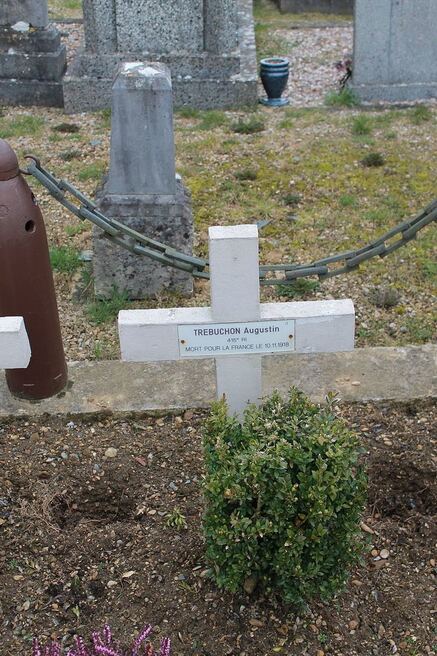
The last Frenchman to die was Augustin Trébuchon, who was a shepherd who played the accordion for village parties before he joined joined the 415th Infantry Regiment as a messenger in August of 1914. On November 11, 1918, he had been sent to deliver a message to the 163rd Infantry Division, which had been ordered to attack an élite German unit, the Hannetons at Vrigne-sur-Meuse, in the Ardennes. He was killed fifteen minutes before the Armistice was supposed to begin. 

Picture
The message that was still in his hand when is body was found said that hot soup would be served at 11:30, half an hour after the ceasefire. Like many grave markers of French soldiers killed on the last day of battle, his says that he died on November 10th. 

Picture
The last American to die was killed just one minute before the Armistice. Henry Gunther had recently been demoted, and may have been trying to redeem his reputation when he charged a German roadblock and was mowed down by a short burst of machine gun fire. This picture is the one that is on his grave marker. 

On this Veteran's Day, we remember all who have served their country and been lost in war, and we pray for peace for the families and loved ones left behind. 

Wednesday, November 10, 2021

Robert Nichols, WWI Poet


Picture
Robert Malise Bowyer Nichols is less well known today than he was during his lifetime, when he was hailed as the worthy successor of Rupert Brooke. Like his friends Siegfried Sassoon and Robert Graves, his poems were graphic remembrances of his time on the battlefields of World War I. However, his writing was more idealistic than either of those poets.

Nichols was the son of a poet.  Educated at Winchester College and Trinity College, Oxford, he joined the Royal Field Artillery in late 1914 as a second lieutenant. He served in the Battle of Loos and the Battle of the Somme and was invalided home with shell shock in 1916.  In 1917, he was attached to the Foreign Office's Ministry of Information and was sent to New York on a publicity tour to drum up support for the war among Americans.

After the war, Nichols about. He was Professor of English Literature at the Imperial University of Tokyo from 1921 to 1924. After that, Nichols moved to Hollywood, where he advised Douglas Fairbanks and wrote plays and screenplays.  His Wings over Europe (1928), was a Broadway hit.

Nichols moved to Germany, then Austria in 1933 and 1934 before settling in southern France for six years. In 1940 he moved to Cambridge, England, where he died in 1944 at the age of 51. He left behind many unfinished works of poetry and fiction. A year before his death, Nichols edited the Anthology of War Poetry, 1914-1918. Of his own war poetry, Invocation (1915) and Ardours and Endurances (1917) are the most widely read.

​Battery Moving Up to a New Position from Rest Camp: Dawn

Not a sign of life we rouse
In any square close-shuttered house
That flanks the road we amble down
Toward far trenches through the town.

The dark, snow-slushy, empty street….
Tingle of frost in brow and feet….
Horse-breath goes dimly up like smoke.
No sound but the smacking stroke

As a sergeant flings each arm
Out and across to keep him warm,
And the sudden splashing crack
Of ice-pools broken by our track.

More dark houses, yet no sign
Of life….And axle’s creak and whine….
The splash of hooves, the strain of trace….
Clatter: we cross the market place.

Deep quiet again, and on we lurch
Under the shadow of a church:
Its tower ascends, fog-wreathed and grim;
Within its aisles a light burns dim….

When, marvellous! from overhead,
Like abrupt speech of one deemed dead,
Speech-moved by some Superior Will,
A bell tolls thrice and then is still.

And suddenly I know that now
The priest within, with shining brow,
Lifts high the small round of the Host.
The server’s tingling bell is lost

In clash of the greater overhead.
Peace like a wave descends, is spread,
While watch the peasants’ reverent eyes….

The bell’s boom trembles, hangs, and dies.

O people who bow down to see
The Miracle of Cavalry,
The bitter and the glorious,
Bow down, bow down and pray for us.

Once more our anguished way we take
Towards our Golgotha, to make
For all our lovers sacrifice.
Again the troubled bell tolls thrice.

And slowly, slowly, lifted up
Dazzles the overflowing cup.
O worshipping, fond multitude,
Remember us too, and our blood.

Turn hearts to us as we go by,
Salute those about to die,
Plead for them, the deep bell toll:
Their sacrifice must soon be whole.

Entreat you for such hearts as break
With the premonitory ache
Of bodies, whose feet, hands, and side,
Must soon be torn, pierced, crucified.

Sue for them and all of us
Who the world over suffer thus,
Who have scarce time for prayer indeed,
Who only march and die and bleed.
—————————————-
The town is left, the road leads on,
Bluely glaring in the sun,
Toward where in the sunrise gate
Death, honour, and fierce battle wait.

Sunday, November 7, 2021

And Now For Something Completely Different


It's November, and for many writers, that means something completely different than what it means for the rest of the population. 

When most people think November, they think Thanksgiving.

Picture
Unless they are crazily dedicated shoppers, when they might think of Black Friday. (I have NEVER done a Black Friday foray! Have you?)
Picture
But for me, like many writers, November means NaNoWriMo.
Picture
NaNoWriMo is short for National Novel Writing Month. Every November, a huge number of writers from around the world try to write a novel in one month. They begin on November 1 (the most dedicated at midnight. Me? I didn't start until 8 in the morning.). In order to win, each has to have 50,000 words written by the time December 1 comes around. What does one win? Bragging rights. Nothing more.

I've competed in NaNo many times in the past, sometimes on the regular NaNo site and sometimes as a teacher/mentor in their Young Writers Program. I don't think I've ever actually won. Most years I finish in the mid 30,000 range. Each year, including this year, I think will be different. 

Whether or not I win this year, it WILL be completely different, because I'm writing about a time period that is very different than anything else I've done in the past. I'm writing about Folsom man in New Mexico. 

Picture
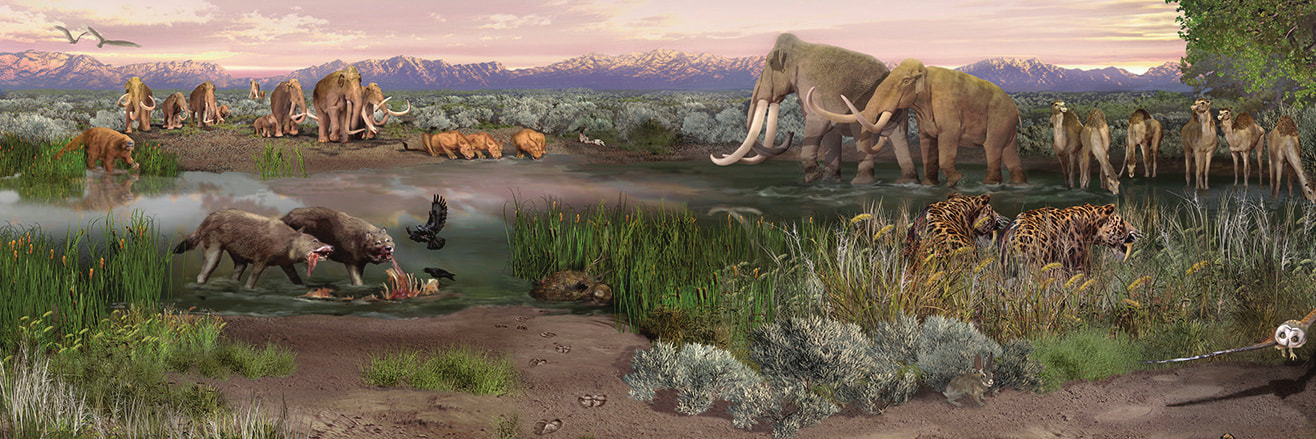
Folsom man wandered New Mexico 10,000 years ago, a little after the last Ice Age. By the time he got here, the mammoths and a lot of the other megafauna were gone. The first evidence of his (and I use man and him in the more general sense of people of both genders) being here were bison antiquus  bones and spearpoints found near Folsom, New Mexico a little over a hundred years ago.

I started thinking about Folsom man in New Mexico years ago, when I first started teaching New Mexico history. I knew nothing about ancient New Mexico. Heck, I didn't know that much about recent New Mexico history. But Patrice Lewis, an experienced and excellent teacher, took me under her wing. She taught me a lot of history - and she taught me a lot about teaching as well.
 
Wild Horse Arroyo. See any bones? Neither did we.
 
Patrice and I went to Wild Horse Arroyo, the site near Folsom where the bones had been found. The site is on private land and is inaccessible to the public except during biannual guided tours led by state archaeologists. 
Picture
The road to Wild Horse Arroyo was little more than a trampled-down path through pasture. Once we arrived, there wasn't much to see; if there were any bones left at the site, they were buried.

But the tour guide was also a great story teller. We stood around by the side of his truck as he explained not only what had been found at this particular location, and the circumstances that led to the discovery, but what the people who had lived here thousands of years ago had been like.

By the time we were driving back to Albuquerque, ideas were swirling around in my mind. 

Those ideas have been swirling for nearly a decade now. I've done a lot of reading and a lot of research, and now I'm writing the story of one of the boys who had been there, that late fall day long, long ago. Of course, I can't actually know him, but I have studied and I can imagine. 

Picture
Jennifer Bohnhoff is a retired middle school English and Social Studies teacher who lives in the mountains of central New Mexico. Her most recent book, A Blaze of Poppies, was published in October 2021 and is a novel set in New Mexico and France during the First World War. Her next book, When Duty Calls, is a novel about the Civil War in New Mexico, and is written for middle grade readers. The one she is currently writing, tentatively titled The Bison Hunters, needs a lot more work before she can even consider publishing it.  

Wednesday, November 3, 2021

David Jones, WWI Poet and Painter


Picture
David Jones is not the most recognized of the World War I poets, but his work is considered among the finest.

Jones was born on November 1, 1895 in a suburb of London. His mother was a Londoner, but his father, who was a printer for the Christian Herald Press, was Welsh and had grown up in Wales. David’s father learned to speak English to help his career. However, he sang Welsh songs, and that stimulated his son’s interest in Welsh language and Welsh mythology.

His parents belonged to the Church of England. David Jones converted to Roman Catholicism after the war. Both his Welsh heritage and his religion are very evident in his artistic work.

Jones knew by the time he was six years old Jones knew that he wanted to be an artist. When he was 14, he entered Camberwell Art School, where he studied literature and the Impressionist and Pre-Raphaelite schools of art. His teachers had worked with Van Gogh and Gauguin, who both influenced his style. By the time the First World War broke out, he was already a very successful watercolor painter, focusing mostly on portraits and landscapes. His work as a wood-engraver was also well known. 

At the beginning of the war, Jones tried to join the Artists' Rifles, but they rejected him because his lungs were weak. Undeterred, he enlisted in the London Welsh Battalion (the 15th) of the Royal Welch Fusiliers. He served on the Western Front from 1915 to 1918.  He was wounded at Mametz Wood, recuperated in England, then returned to the Ypres Salient, where he participated in the attack on Pilckem Ridge at Passchendaele. In 1918 he contracted trench fever and nearly died. He spent the rest of the war stationed in Ireland.

Like many men, Jones’ own personal war continued long after the Armistice was signed. Jones suffered from shell-shock, which is now called post-traumatic stress disorder. In order to combat it, he threw himself in to his art. In 1932, his work has risen to such a frenzied state that he finished 60 large paintings in just four months. He also worked on writing, including a first draft of his epic work In Parenthesis. But such drive could not continue, and in October 1932 Jones suffered a nervous breakdown. So profoundly was Jones shaken that he was not able to paint again for 16 years.  

During the period in which he could not paint, Jones work on In Parenthesis, an epic recalling his experiences in the war through the eyes of a fictional character. The title implies that the events take place in a parenthesis of life – during a period that was set aside and distinct from what came before and what came afterward. It is a long and lyrical poem that is at once specifically about one man’s experiences in a specific war and about war in general, and it is filled with Biblical allustions, Welsh folklore, and allusions to Shakespeare and Malory’s Morte d’Arthur.

Praise was heaped on In Parenthesis and on Jones when it was published in 1937. It won the Hawthornden prize, which at the time was Britain’s only major literary award. T.S. Eliot praised the poem for using words in a new way and W. H. Auden declared it "the greatest book about the First World War." The war historian Michael Howard called it "the most remarkable work of literature to emerge from either world war." Graham Greene thought it "among the great poems of the century." In 1996 the poet and novelist Adam Thorpe said "it towers above any other prose or verse memorial of ... any war." The art historian Herbert Read called it "one of the most remarkable literary achievements of our time."  Dylan Thomas wished that he had "done anything as good as David Jones." Hugh MacDiarmid announced that Jones was "the greatest native British poet of the century," and Igor Stravinsky thought him "perhaps the greatest living writer in English". Some have said that Jones did for England what Homer did for the Greeks.

Despite all the praise heaped upon Jones, he is not well read. His highly allusive poems are difficult and long; definitely not appropriate for including in a blog such as this. Reading one is a major undertaking. His visual arts have ascended even as his written ones have fallen in favor, and his paintings now command a hefty price.

In 1970, Jones fell and broke the ball of his femur. He never fully recovered and died on October 28, 1974. 


Jennifer Bohnhoff's novel A Blaze of Poppies is set in New Mexico and the battlefields and field hospitals of France during World War I. 

Great Christmas Books for Middle Grade Readers

  Great Christmas Books for Middle Grade Readers   Everyone loves a good Christmas read. Here's a short list of some of the best for mid...