Showing posts with label Pancho Villa. Show all posts

Thursday, February 29, 2024

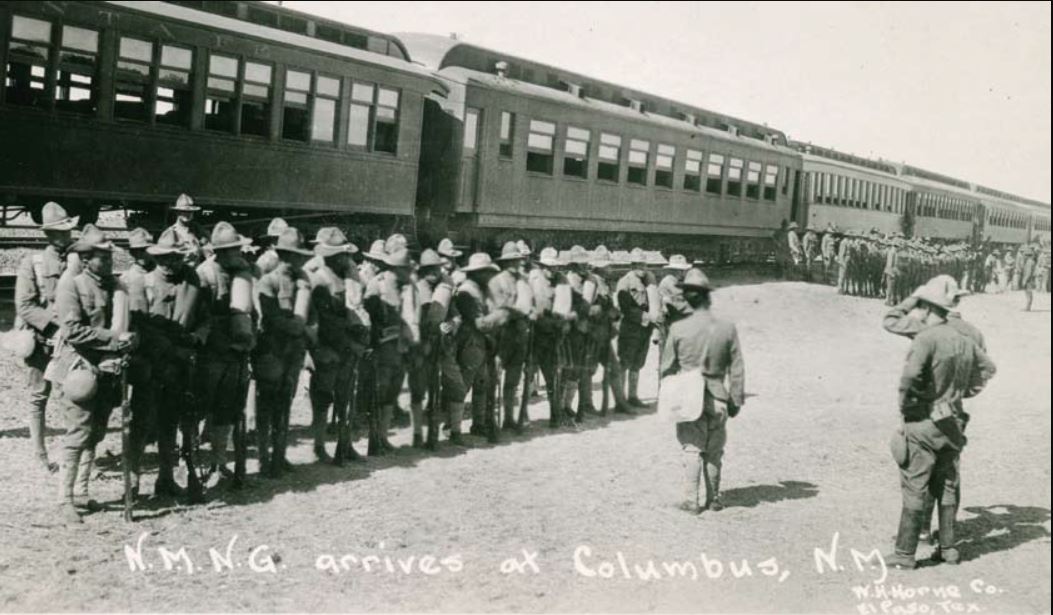
Pancho Villa and the Raid on Columbus


Sunday, November 19, 2023

John Pershing: The General of the Armies


Picture
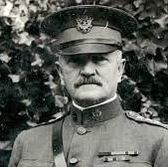
General John Joseph Pershing is the only person who has held the special rank of General of the Armies of the United States during his lifetime. (The only other people to have held this rank are George Washington, who was awarded it posthumously in 1976, and Ulysses S. Grant who received the honor in 2020.)  His military career spanned several wars during the period when the United States was becoming a force to be reckoned with on the world stage. Through his many famous and talented protégés, his influence continued long after his retirement.

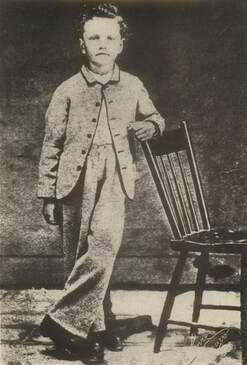
PictureJohn Pershing as a young boy. [The Story of General Pershing, Everett T. Tomlinson, 1919,)
Pershing was born on a farm in Laclede, Missouri on September 13, 1860.  His mother was a homemaker and his father, John Fletcher Pershing, owned a general store and served as Laclede’s postmaster. During the Civil War, John Fletcher worked as a sutler, a civilian merchant who accompanied an army and sold goods to soldiers, for the Union. John Joseph was the oldest of nine children, six of which survived to adulthood. Pershing's family was not wealthy. Beginning at age 14, the oldest son was expected to contribute to the family. John began working. He also began putting aside money for his education, as his family had told him that schooling was not something they could afford. 

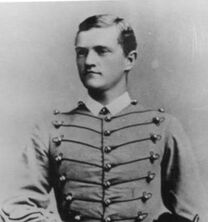
PictureJohn Pershing as a West Point cadet (Photo: public domain)
Pershing studied at Kirksville Normal School (now Truman State University), where he received his teaching degree in 1880. He taught African-American schoolchildren at Prairie Mound School, but became interested in law and went back to school to become a lawyer. When he decided that he could not get as good an education as he wanted in Missouri, he applied to the Military Academy at West Point, where cadets received a high-quality education for free in exchange for military service. At West Point, his leadership skills became apparent and he found himself in many command roles. He was the class president all four years. In 1885, when President Ulysses S. Grant’s funeral train passed West Point, Pershing commanded the honor guard. 

After graduating in 1886, Pershing was commissioned as a 2nd Lieutenant. He reported for duty in 6th U.S. Cavalry Regiment in New Mexico, where he participated in several Indian War campaigns, including fighting the Apaches led by Geronimo.

Next, Pershing was posted to the University of Nebraska, where he taught military science. During his four years there, Pershing earned the law degree he’d so long wished for.
 
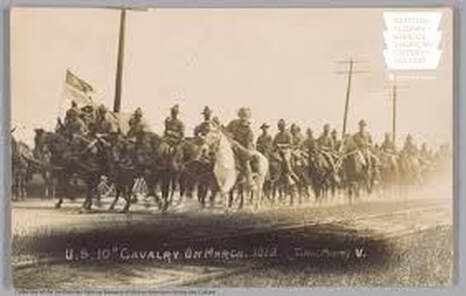
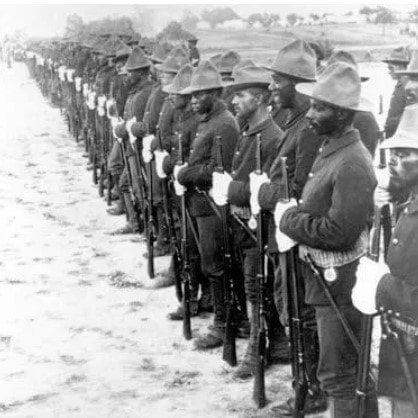
In 1896, he was promoted to 1st Lieutenant and assigned to a troop of the 10th Cavalry Regiment, one of the original regiments of Buffalo Soldiers, racially segregated black units. This began Pershing’s long association with black units.
Picture
In 1897, Pershing was sent back to West Point, where his strict ways with the students made him an unpopular teacher. The students nicknamed him Black Jack. By World War I, the epithet that was supposed to be derogatory had lost its sting and become popular. It remained with him for the rest of his life.
 
When the Spanish-American War broke out, Pershing was again selected to command the Tenth Cavalry, this time as their quartermaster.  On July 1, 1898 he led his men in the Battle of San Juan Hill alongside Theodore Roosevelt’s famous Rough Riders.
 Pershing later recalled that 
Picture
...the entire command moved forward as coolly as though the buzzing of bullets was the humming of bees. White regiments, black regiments, regulars and Rough Riders, representing the young manhood of the North and the South, fought shoulder to shoulder, unmindful of race or color, unmindful of whether commanded by ex-Confederate or not, and mindful of only their common duty as Americans.” 
PicturePershing (left) with the commander of the Philippines Constabulary (right) and Moro chieftains in 1910 (Photo: Fort Huachuca Museum)
After the war, Pershing was assigned to the Office of Customs and Insular Affairs, which oversaw the overseas territories the United States had taken Spain, including Cuba, Puerto Rico, the Philippines and Guam.
 
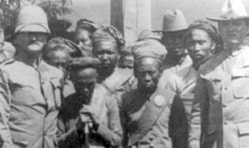
In the Philippines, Pershing fought against both the Moros, an indigenous Muslim people who had previously fought for their independence from the Spanish, and a wider Filipino insurrection. Pershing studied Moro culture and dialects, read the Koran, and built relations with various Moro chiefs in an effort to win them over.


Picture
From 1903 to 1905, Pershing, now a Captain, attended the War College. After his graduation, he was given a diplomatic posting as military attaché to Tokyo, where he was an official observer in the Russo-Japanese War of 1904-05.

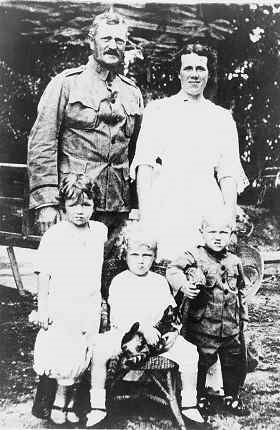
He met and married Helen Frances Warren, the daughter of Francis E. Warren, a powerful Republican Senator from Wyoming. They had four children: Helen, Ann, Warren, and Margaret. Pershing took his family with him when he returned to the Philippines for a few years, then later posted to San Francisco.


In 1906, President Roosevelt used his prerogative to promote Pershing to brigadier general. This was a controversial move, and many suggested that Pershing’s marriage had influenced the President. At the time, promotions were handed out based on seniority rather than merit, and Pershing had bypassed three ranks and skipped over 830 officers ahead of him. However, the President had the power to appoint general staff officers, but not lower-ranking ones and he chose to do this for the man he’d learned to respect in Cuba during the Spanish-American War. 
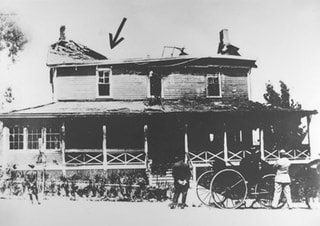
PicturePershing’s San Francisco home after the fire, with the arrow indicating the window through which his son was rescued (Photo: National Park Service)
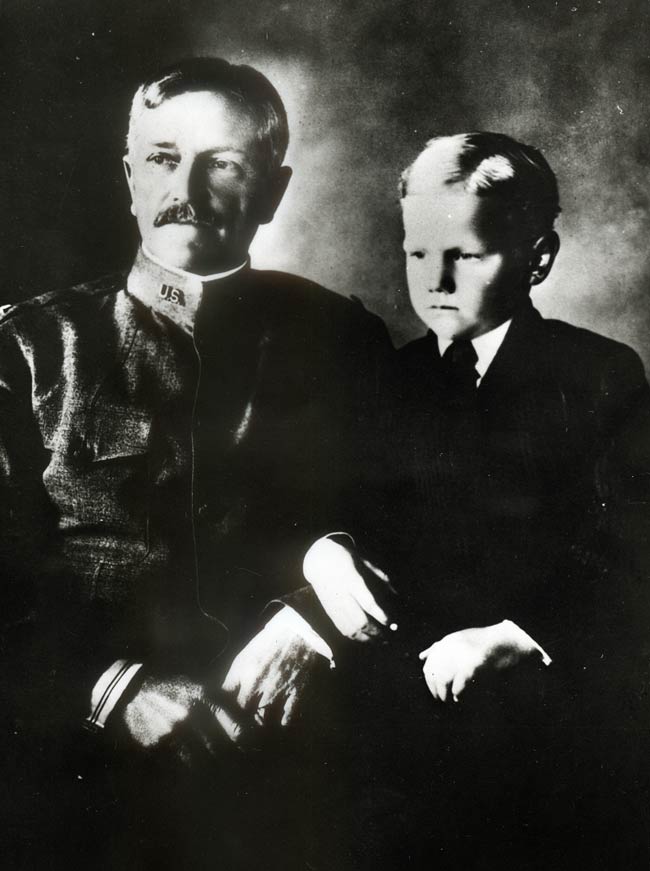
In 1915, personal tragedy struck when his home in San Francisco’s Presidio caught fire. Pershing’s wife and his three daughters were killed in the blaze, leaving him a widower with a five-year-old son named Warren. Pershing’s sister May took charge of the boy’s care and upbringing.

Picture
Pershing with his son Warren around the time of World War I. [Missouri Military Portraits, P1197-014515
Instead of taking time to grieve, Pershing leapt into action, leading 10,000 men on a punitive expedition into Mexico in an attempt to capture Pancho Villa, the bandit and revolutionary who had led several raids into U.S. territory, including the March 9, 1916 raid on Columbus, New Mexico. It was the first time the U.S. Army used mechanized vehicles in war. Cars, trucks, and airplanes were tested out in the deserts of Mexico and one of Pershing’s young officers, the future General George S. Patton, led the first motorized assault in U.S. military history, and killing Villa’s second-in-command. From the very start, the Punitive Expedition was doomed to failure. President Wilson, worried that a war might start, restricted the expeditions movements.  

Pershing described the failed mission as
“a man looking for a needle in a hay stack with an armed guard standing over the stack forbidding you to look in the hay.”
Picture
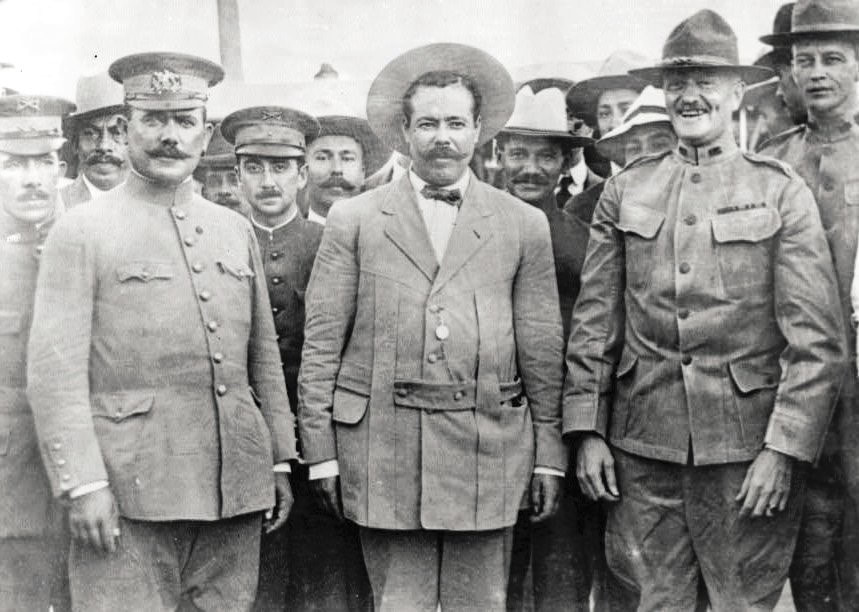
Pershing (front, right) with Pancho Villa (center) half a year before the expedition, when Villa was still a friend to America. At the far right, George Patton looks over Pershing’s shoulder (Photo: University of Texas at Austin)
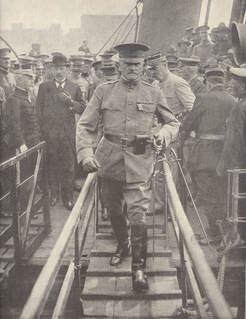
Soon after the Punitive Expedition returned to American soil, the United States entered World War I. President Woodrow Wilson had intended for General Frederick Funston to lead the expeditionary force into Europe. However, Funston died of a heart attack in February 1917, Pershing was selected to take his place. Again, Pershing received a promotion, this time jumping from major general to full, four-star general, skipping over the rank of lieutenant general.
PicturePershing arriving in Europe (Photo: gwpda.org)
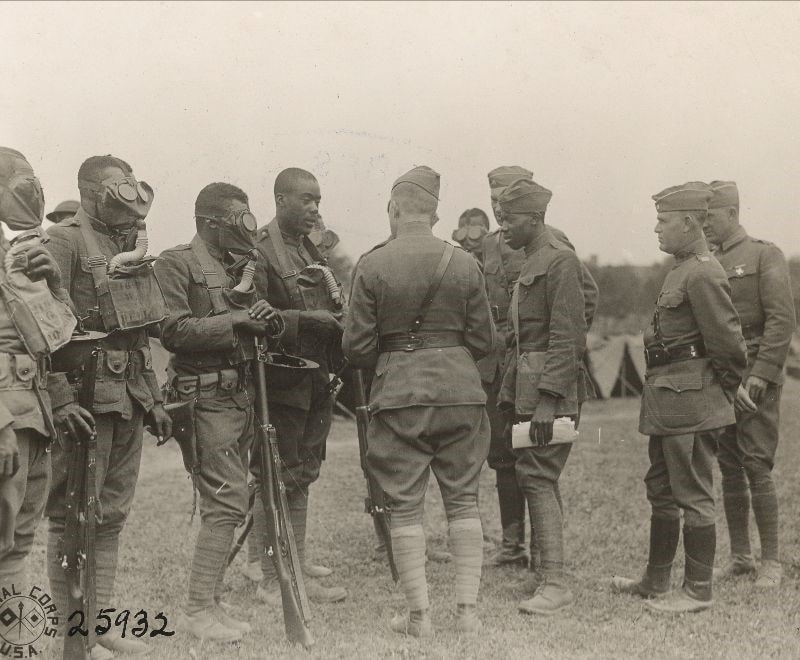
Pershing oversaw the organization, training and supply of the professional army, the draft army, and the National Guard, but he was unwilling to command under the kind of restraints that had plagued the Punitive Expedition. Before he would take command, Pershing made sure that will would give him unprecedented authority to run the AEF. In exchange, Pershing agreed not to meddle in political or national policy issues. This included Wilson’s racial policies, which kept the army segregated. Although Pershing had proved that he was willing to lead colored soldiers in battle, he could not in Europe. Pershing, who wanted to keep American troops under American command instead of allowing them to become reinforcements in British and French units, allowed two black divisions to be transferred to French leadership so that they would be allowed to see combat. 

Picture
Buffalo Soldiers of the 92nd Division inspecting gas masks in France, 1918 (Photo: National Archives and Records Administration)
At the end of the war, Pershing pushed the Supreme War Council, to reject German requests for an armistice, and instead occupy Germany. He argued that German people might later feel they were never “properly” defeated and war would again break out. Woodrow Wilson, anxious to finish the war before the upcoming mid-term elections, and Britain and France, tired of war, disagreed and the armistice signed. During his own tenure as President, Franklin D. Roosevelt acknowledged that Pershing had been right. 
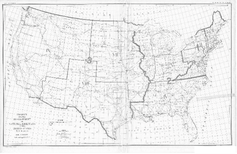
PictureOne version of the Pershing Map (Photo: U.S. Army Corps of Engineers)
Pershing returned to the United States a hero. In 1919, Congress authorized President Wilson to promote him to the rank of General of the Armies of the United States, a rank that made him the second-highest paid government official after the President. It also allowed General Pershing to be on “active duty” for the rest of his life and continue to be available for assignments.

General Pershing served as Army Chief of Staff from 1921 to 1924. During this time, he created a map of a proposed national network of military and civilian highways, which became the foundation of the Interstate Highway System. 


When the United States entered World War II, he served as a consultant. Many of his protégés, including George C. Marshall, Dwight Eisenhower, Omar Bradley, Leslie McNair, Douglas MacArthur and George S. Patton led troops. His memoir, My Experiences in World War, won the Pulitzer Prize for history in 1932.
Picture
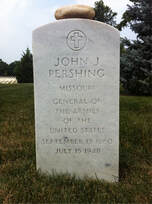
After suffering a stroke, John Pershing died in his sleep on July 15, 1948. His body lay in state in the rotunda of the U.S. Capitol. An estimated 300,000 people came to see his funeral procession He was buried with honors in Arlington National Cemetery, at a site known as Pershing Hill. The graves of Americans whom he commanded in Europe surround his.


Picture
Jennifer Bohnhoff's novel A Blaze of Poppies tells the story of the Punitive Expedition and America's involvement in World War I from the point of view of two New Mexicans: a national guardsman and a female rancher. It is available in ebook and pa

Wednesday, March 9, 2022

The Punitive Expedition Against Pancho Villa


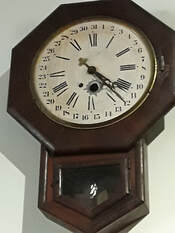
PictureThe clock at the Columbus train station, stopped at the time of the attack by a bullet. It is now in the museum at Pancho Villa State Park.
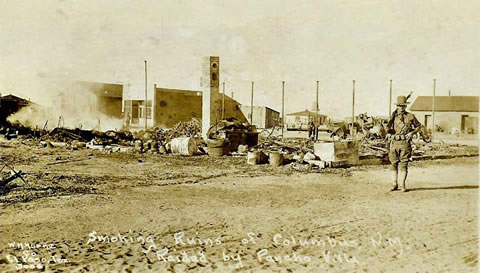
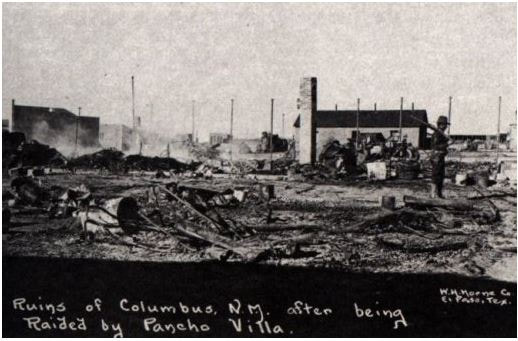
Today marks the 106th anniversary of Pancho Villa's raid on Columbus, New Mexico. On March 9, 1916, at approximately 4:00 am, a group of just under 500 Mexican revolutionaries attacked the sleeping town while their leader, General Francisco “Pancho” Villa, watched from a nearby hill. The attack was the first and only ground invasion of the continental United States since the War of 1812. Ten American civilians and eight U.S. soldiers from the adjacent Camp Furlong lost their lives.

The attack came after a long period of Mexican political unrest and may have been caused by Villa's frustration that President Woodrow Wilson and the American government had chosen to recognize a political rival, Venustiano Carranza, and help him win the election and become President of Mexico. Villa, who had been supported by the U.S. in the past, was also desperate supplies for his beleaguered army and may have thought that Columbus and the nearby Army camp would be a good place to get what he needed.

Picture
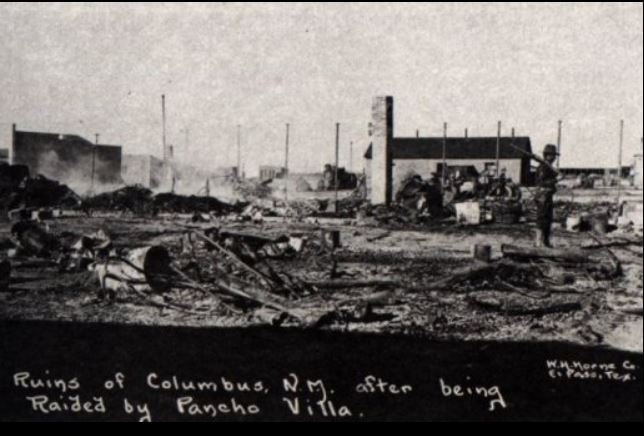
Much of Columbus burned to the ground during Villa's raid. Public Domain
Picture
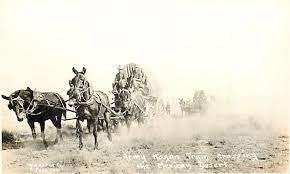
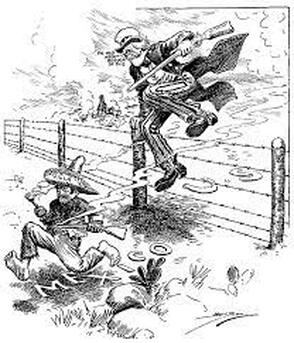
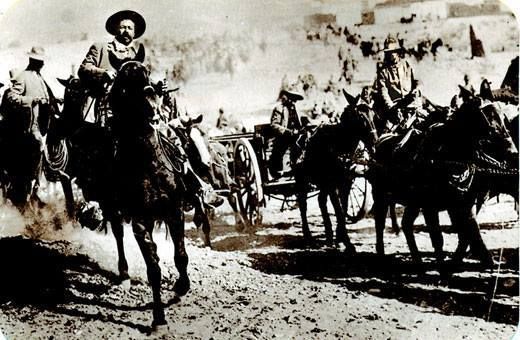
In response, Wilson ordered a punitive expedition into Mexico to capture Villa. General John J. Pershing began gathering troops at Camp Furlong (sometimes called Camp Columbus). Pershing planned a two-pronged attack. The quicker force, of mostly soldiers on horseback, went south from the village of Hachita, in New Mexico's bootheel. The slower force, which included wagons and trucks filled with gear and supplies, went south directly from Columbus.

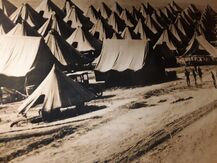
​By April 8th, General Pershing's force of over six thousand had traveled four hundred miles into Mexico. There they established a base in the town of Colonia Dublan. The U.S. Army had never before attempted anything of this magnitude, and the logistics of supplying Camp Dublan proved difficult. 

​President Wilson had assumed that the Mexican government would support a raid intended to capture Pancho Villa. Instead, Mexico refused to offer the U.S. expedition any aid. This included denying the U.S. the use of the Mexican Northwestern Railway to transport supplies. Food and supplies were brought in by horse and mule trains. Soon, the whole operation was at a standstill.

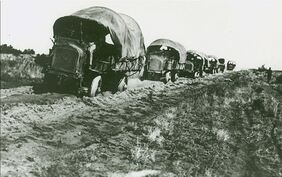
PictureJeffery quads in Mexico.
When U.S. Secretary of War Newton Baker found out about this dilemma, he found $450,000 of unappropriated funds and purchased 27 new trucks. The Jefferys had four wheel drive, and were as tough as mules. Even with the trucks,  moving supplies was not easy. Many of the roads depicted on available maps proved to be no more than trails that became impassable when wet. Army engineers found themselves busy rebuilding roads and restringing cut telegraph lines. 

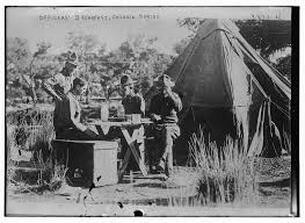
PictureOfficers breakfast, Camp Dublan
​The situation came to a head in the middle of April, when a detachment of troops from Carranza's army attacked the American troops at Parral. The Americans were able to drive back the Mexicans, killing fourteen of them, but one American was killed, and one wounded. From then on, Pershing kept the majority of his men at Camp Dublan, sending out only small scouting parties and detachments to locate Villa. 

Picture
By February 1917, the Punitive Expedition to Mexico was over. Newton D. Baker, claimed that the Expedition had “fully and finally accomplished . . . a display of the power of the United States into a country disturbed beyond control of the constituted authorities of the Republic of Mexico as a means of controlling lawless aggregations of bandits and preventing attacks by them across the international frontier." 

General Black Jack Pershing crossed back into the United States and parade triumphantly through the streets of Columbus with 10,690 soldiers and some 2,700 refugees. Two hundred of the refugees were Americans who had owned ranches south of the border. Another five hundred were Chinese immigrants who faced discrimination in Mexico and were moving north in search of a better life. The remaining two thousand were Mexican citizens escaping the violence of their country’s long civil war. 

The fact that Pershing’s Army brought back so many refugees proved that Mexico remained a dangerous place. Although depleted by casualties and desertion and not the menace they had been, Pancho Villa and his Villistas were still on the loose.


Picture
The raid on Columbus and the expedition into Mexico are important parts of the story told in A Blaze of Poppies, Jennifer Bohnhoff's historical novel about life on a ranch in Southern New Mexico. It is available as a paperback or ebook from Amazon, or a signed paperback copy can be purchased directly from the author.

Monday, July 29, 2019

The Raid on Columbus


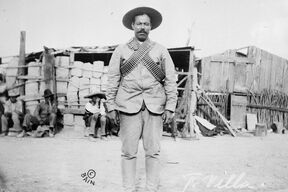
PicturePancho Villa
Many people consider 9/11/2001 the day that America lost its feeling of security. But al-Qaeda’s suicide attacks of the four hijacked that crashed into the World Trade Center in New York City, the Pentagon just outside Washington, D.C., and a field in Pennsylvania was not the first time enemies had attacked on American soil. The United States suffered invasions during the War of 1812, the Mexican American War, and in 1916, when Pancho Villa raided the New Mexican town of Columbus.

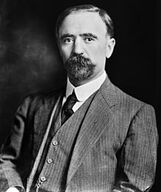
PictureFrancisco I. Madero
 In 1910, Mexico became embroiled in a revolution that was intent on radically transforming its culture and government. It began when the 31-year-long regime of Porfirio Díaz rigged an election against a challenging wealthy landowner named Francisco I. Madero. This led to an armed rebellion that put Madero into power. Madero’s presidency couldn’t unite the people. Conservatives saw him as weak and liberal. Former revolutionary fighters and the dispossessed saw him as too conservative. Madero resigned in February 1913, and was later assassinated. 

PictureVenustiano Carranza
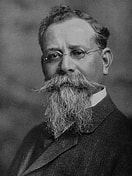
Backed by business interests and other supporters of the old order, General Victoriano Huerta’s counter-revolutionary regime came to power. In July 1914 a coalition of regional revolutionary forced him out and one of their leaders, Venustiano Carranza, took control with the support of American President Woodrow Wilson.  

Not all of the revolutionaries supported Carranza. One of the leaders in opposition was Pancho Villa, the commander of the northern division of the army centered in Chihuahua. Villa had received a lot of support from Americans in the past and was shocked when this support dried up. Lacking military supplies, money, and munitions, Villa’s army degenerated into a disorganized mob that wandered around northern Mexico, foraging, raping, and looting as they went.  On March 9, 1916, his troops crossed the border ant attacked the tiny town of Columbus, New Mexico.

At the time of the attack, New Mexico had only been a state for four years, but that doesn't mean it was a "new" place. Native Americans had lived in it for thousands of years. In 1598 Spain colonized it, but lost it when Mexico gained its independence in 1824. In 1848, at the conclusion of the Mexican-American War, the United States annexed New Mexico as a territory. It was finally admitted to the Union as the 47th state on January 6, 1912. It continues to be the state with the highest percentage of Hispanic and Latino Americans, and still has close ties with Mexico.

Historians still argue about why Villa crossed the border. One theory is that he wanted to punish the United States for withdrawing its support for his cause. Another is that merchants in Columbus had cheated him in an arms deal. Finally, Villa might have been desperate for the arms and horses he though he could get from the raid.
Picture
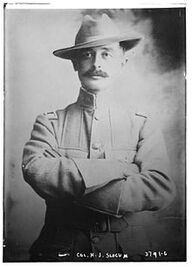
The day before the attack, a ranch foreman named Juan Favela rode to Camp Columbus, a small post established to patrol the border. Favela warned Colonel Herbert Jermain Slocum, the commander of the 13th Cavalry, that Villa and his forces were in Palomas, a bordertown only three miles south of Columbus.  Slocum reinforced the troops at the Border Gate and stepped up patrols along the 65-mile border, but he wasn’t overly concerned. Although not all men were in garrison, the 13th Cavalry Regiment had a headquarters troop, a machine gun troop, and four of the seven rifle troops deployed to patrol the border: 12 officers and 341 men in all. Villa, he was sure, wouldn’t dare attack a force that large. Captured Villistas later revealed that the spies Villa sent into Columbus returned with reports that only thirty or so soldiers were garrisoned at the Camp, however, and this misinformation may have convinced Villa of Columbus’ vulnerability.

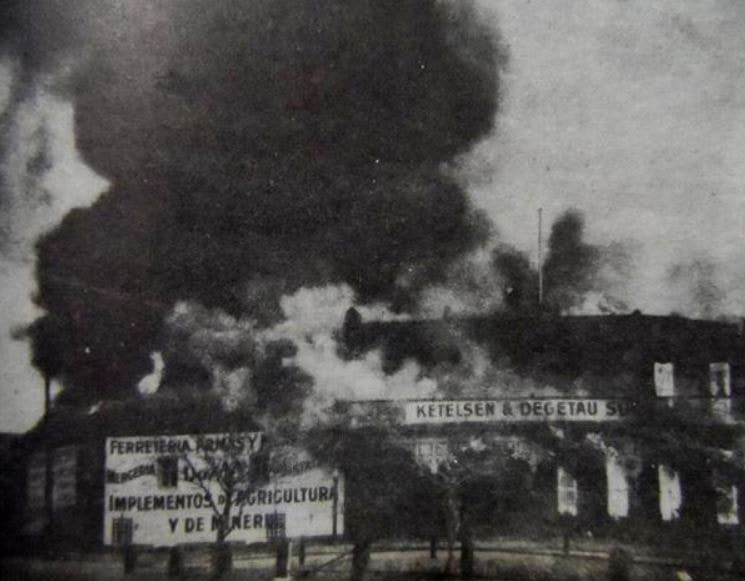
PictureColumbus burning during the raid
Villa crossed the border about midnight. He took up a position on Cootes Hill overlooking Columbus, and at 4:15 am on the morning of March 9 launched a two-pronged attack on the town from the west and southeast. Most of his 380 man army left their horses with Villa and moved in on foot.

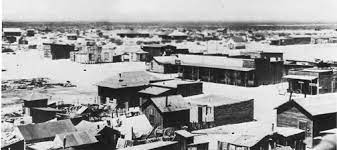
​Columbus was a small town, with only a few adobe houses, a couple of hotels, a grocery store, a drug store, a few mercantile businesses and a railway station lining its sandy streets. People in both the town and garrison awoke in the dark to shouts of "Viva Villa!” and “Viva Mexico!"  Villa’s army looted the stores and set them on fire. If their proprietors got in the way, they were shot. J.J. Moore, who owned a mercantile shop, was. So was C.C. Miller, the town’s druggist. The fire spread to the Commercial Hotel, where the Villistas robbed people as they fled the burning buildings. Four civilians were killed there, six elsewhere. 

Picture
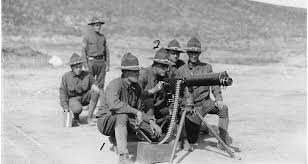
But Columbus didn’t go down without a fight. Many of the townspeople defended themselves with rifles and shotguns. 2nd Lt. John Lucas heard the noise and, so hastily that he never got into his boots, made his way from his private quarters to the camp's guard tent, where he broke into the lockers that kept his troop's machine guns secure. Lucas set up four emplacements of men, each with a Hotchkiss M1909 Benét-Mercié machine gun.  He was soon joined by 30 troopers armed with Springfield rifles.

At first the night was so dark that the soldiers couldn’t see their enemies. The only way to locate Villistas were the muzzle flashes as they fired. As the Commercial’s blaze grew, it backlit the Villistas, making them easy targets. Close to 20,000 rounds were fired from the machine guns during the 90-minute fight.

Picture
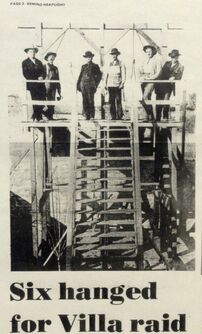
As the sky lightened, Villa's bugler called a retreat. Villa left behind his dead and wounded and slipped back into Mexico.  The dead Villistas and their horses were dragged to a pit, doused with kerosene and set on fire. The lives ones were jailed. All but one were later hanged. Columbus went through a period of intense mourning. The tiny town that no one had heard of was suddenly on the front page of every paper in America. Its notoriety didn’t last long, however. America’s entrance into World War I made a Mexican’s raid on a small border town in a little known state pale into obscurity. Americans wouldn’t feel that vulnerable again until Pearl Harbor.

Jennifer Bohnhoff teaches school in rural central New Mexico. She has written a number of historical fiction novels and is currently at work on one set in Southern New Mexico during the time of the Villa raid.

Bandelier National Monument: A Beautiful Walk through History

Last week my hiking buddies and I went to Bandelier National Monument, and got not only a beautiful hike, but a lesson in New Mexico history...