Showing posts with label World War II. Show all posts

Friday, December 20, 2024

Christmas 1944


Wednesday, December 11, 2024

The 80th Anniversary of Two Brutal Massacres


This December marks the 80th anniversary of two terrible massacres. Both took place during World War II, but in different theaters of the war. 

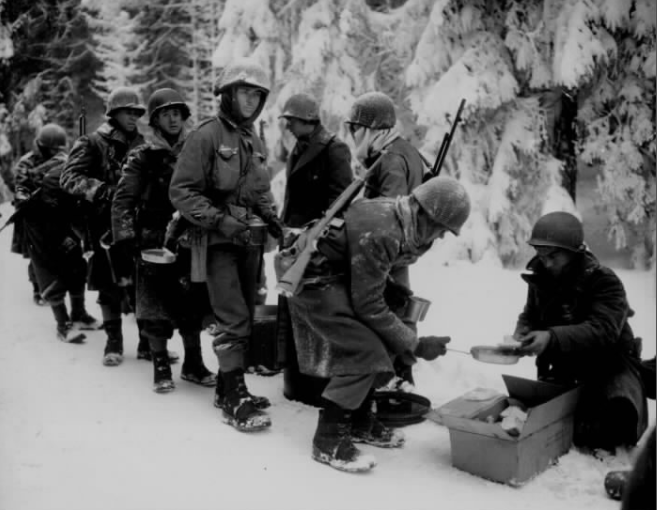
The Battle of the Bulge, which began on December 16, 1944. By the time it ended, 40 days later, approximately 600,000 American troops had participated in the largest battle ever fought by the US Army. Fighting in brutal conditions and freezing temperatures, Allied forces managed to stop the Nazi war machine from reversing the gains the Allied forces had made ever since the Normandy invasion. The Allies pushed the German Army back, but at a great price. The U.S. Army lost 19,000 men and suffered more than 80,000 casualties. 23,000 Americans were captured and taken prisoner. 

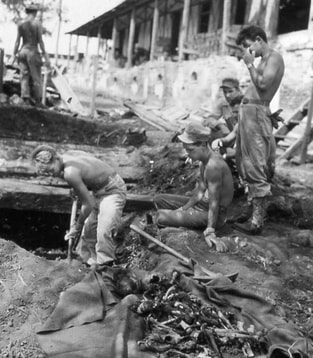
One of the most horrific events within the Battle of the Bulge was the Malmedy Massacre.  On December 17, 1944, roughly 80 American POWs were led to a field, where they were machine gunned to death by a Waffen-SS unit. 43 men managed to escape into the surrounding forest. Although Allied commanders started receiving news of the massacre by the evening that it occurred, the area was in German hands. Americans didn’t regain access to the area until January 13, 1945, when a Graves Registration Platoon entered the site. Because of the snow and freezing temperatures, the bodies were remarkably well-preserved, but hard to locate.  An engineer platoon used metal detectors to help find them. The field was still a frontline combat area. The infantry occupied foxholes in one corner of the field, and German artillery fire repeatedly disrupted the work. Despite this, 72 bodies were found. After autopsies in a nearby abandoned railway building that had no water or electricity, the Graves Registration Platoon was able to determine by the nature of the wounds that the men were executed, rather than killed in combat. Most of the dead did not wear their mandatory identification tags. Why that was has never been determined. Despite the lack of tags, the GRREG soldiers managed to identify every single victim.


source: WikiCommons


But the massacre at Malmedy was not the only one that happened in December 1944. On the other side of the world, near the city of Puerto Princesa in the Philippine province of Palawan, another horrific event took place on December 14, 1944. It is called the Palawan massacre.

Picture


The men killed in the Palawan massacre had been interned in Palawan Prison Camp, an old Philippine Constabulary barracks since August 12, 1942, when they’d arrived in two transport ships. Originally 300 in number, the men were survivors of the Battle of Bataan and the Battle of Corregidor. For the next two years, they cleared land and constructed a concrete runway for their captors, using only hand tools, wheelbarrows and two small cement mixers. Half of the prisoners were sent back to Manila on September 22, 1944. A month later, the airstrip and nearby harbor came under allied attack and the prisoners were forced to dig trenches 5 feet deep and 4 feet wide for use as bomb shelters. Afraid that the advancing Allies would be able to rescue the prisoners of war, the Japanese sounded an air raid siren. Once the 150 men had entered the trenches, Japanese soldiers set them on fire using barrels of gasoline. Prisoners who tried to escape the flames were shot down by machine gun fire. Others attempted to escape by climbing over a cliff that ran along one side of the trenches, but were later hunted down and killed. 139 of the prisoners were killed. 11 men escaped and were aided by Filipino scouts and guerrillas.

The testimony of one survivor, Pfc. Eugene Nielsen, convinced the US military to embark on a series of rescue campaigns to save the POWs in the Philippines. The raid at Cabanatuan on January 30, 1945, the raid at Santo Tomas Internment Camp on February 3, 1945, the raid of Bilibid Prison on February 4, 1945, and raid at Los BaƱos on February 23, 1945 all saved POWs from horrible deaths. 

Former Cabanatuan POWs in celebration.wikipedia


Sunday, May 18, 2014

Biking to Amblie

Biking through Normandy, suitcases on our backs.


 The Bohnhoff boys laughingly refer to family vacations as death marches.  We routinely try to pack too many adventures into too little time.  Frequently we don't plan adequately for little things like eating and sleeping.

I researched the story known as Code: Elephants on the Moon while on one such vacation with my family in the summer of 2005.  Our plan was to take an overnight flight to Paris, spend one night sleeping and getting over jet lag, then take a train to Caen, and a bus to Ouistreham where we would pick up the bikes I had reserved over the internet, then ride 12 miles to Amblie, a little Norman village where we had rented a house for the week.  While exhausting, this plan seemed doable.  We packed lightly in suitcases that converted to backpacks and headed out with high hopes.

But things seldom go as planned.  We ended up spending our first night in Paris in Dallas after our flight was delayed 24 hours.  Determined to keep on schedule, we got off the plane midmorning and immediately made our way to the St. Lazaire train station, just in time to buy tickets and scramble aboard a train. We had no idea that some seats were reserved and some were not, so of course we sat in seats reserved by others, who happened to be French and not at all entertained by our lack of understanding.  Soon we were on our way.  Without, of course, any provisions for lunch.  But that was okay.  After all, we had gotten a small breakfast on the plane and the train trip was only two hours.  We would be in Caen in time for lunch.

And we were.  But, careful travelers that we are, we decided to first make our way to the bus station and check the schedule before eating.  Of course, we arrived just in time to buy tickets and leap onto an out bound bus.  No problem.  Caen is only 17 km from Ouistreham.  Google maps says it takes 16 minutes.  21 in traffic.  But Google maps didn't account the frequent stops that a bus makes.  I don't remember how long the ride actually took us, but by the time we arrived in Ouistreham we were hungry and tired and jet lag had caught up with us.  Big time.

We must have looked terrible by the time we dragged our sleep deprived bodies into the bike shop; terrible enough that the workers adjusted the heights of the seats, then told us that they would drive us to Amblie in their little car and deliver the bikes the next day  My husband was too proud to accept this offer, but I wasn't.  While he and my two older sons rode through the picturesque countryside my youngest son and I careened through the French countryside in the back of a tiny car being driven by a woman who spoke French as rapidly as she drove. Before she left us she made sure that the proprietess of the property we rented knew that we needed a ride to the nearest market to get supplies.  We were in good hands.

Thursday, April 24, 2014

The Bicycles of War


Private R.O. Potter of The Highland Light Infantry of Canada
 repairing his bicycle, France, 20 June 1944.

We didn't exactly storm the beaches when my family traveled through Normandy on bicycles.  We tottered along back roads and through the narrow streets of villages.  We were no army; just five Americans doing our best to absorb the sights, sounds and scents of a beautiful land.


Not everyone who's been on a bicycle had such idyllic purposes.

Bicycles were used more extensively during World War Two than I had ever guessed.  In 1939 every  Infantry Division within the Polish Army had a company of bicycle-riding scouts. that included 196 bicycles.  The Jaeger Battalions of the Finnish Army used bicycles to deploy rapidly against the 1941 advances of the Soviet Union, switching to skis when the snow became deep. The Finns were still using bicycles in 1944, when the Germans had destroyed so many Finnish roads that tanks and other heavy equipment had to be abandoned.

Bicycles were used in France by the occupying German forces.  They used bicycle patrols to cover areas quicker than patrols on foot and to send messages.  They were used more often as gas became more difficult to attain. 

The Allies used bicycles in France during World War II also.   Canada's Highland Light Infantry used bicycles to cover the French countryside quickly. You can see pictures of their bikes stacked within the landing craft that took them to the beach on my pinterest board:  http://www.pinterest.com/jbohnhoff/  

Even some of the American forces in France had bicycles.  US forces dropped folding bikes, called "bomber bikes" out of planes behind enemy lines for use by our paratroopers and for messengers and French Resistance fighters who were supporting us.  


I haven't included a single bike in Code: Elephants on the Moon.  Perhaps I should in a future revision of the manuscript.  Maybe by the time this book comes out in print (as opposed to an ebook) Sergeant Johannes Hegel will be leading his patrols through the narrow streets of Amblie and Reviers on bicycle.

Keeping Time with the Romans

  Modern societies rely on precise and standardized timing. Our schedules are synchronized to prevent chaos, ensure safety, and keep complex...