Monday, May 2, 2016

A good experience at a bad craft show


Picture
Two weekends ago I sold my books at a craft show.

​Well, actually, I tried to sell books at a craft show, but when there's no one to sell to, you don't sell much.

It was the slowest, least-attended show I've ever been to. I managed to sell enough books to cover the cost of having a table, but not much else.

But I got a great new jacket and a wonderful experience out of what otherwise would have been a pretty bad day. Here's the story: 

The booth next to mine was manned by Holly Woelber, whose business, m-g designs, creates beautiful blanket-jackets. They were colorful, looked warm and comfortable, and very, very southwestern. (Indians have been making jackets out of their blankets for a long time.)

I told Holly that I was writing a Civil War book set in New Mexico and would like one of her jackets to wear while talking about it, but I would have to sell some books before I could buy one. A little later, Holly (whose sales were no better than mine, for the same reason) bought The Bent Reed from me and began to read.

A little later she walked over and told me she hated the mother in my book. Towards the end, she came back again. This time, there were tears in her eyes. She told me she understood why the mother was the way she was, and that she loved the book. She then asked me which jacket I was planning to buy, and when I picked one, she gave it to me, and encouraged me to keep writing.

I will be forever grateful to Holly, not only for the beautiful jacket, but for her encouragement. 

Friday, April 29, 2016

Real Characters


Sunday, April 10, 2016

Mission completed


Picture
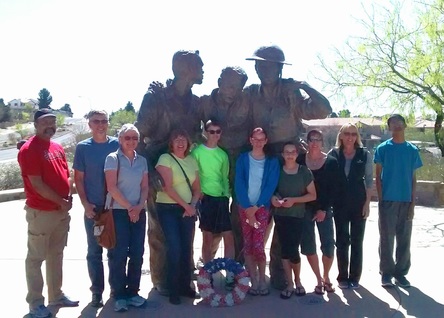
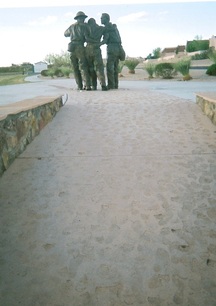
Last month I met ten friends and some of their family members at the Bataan Sculpture in Veteran's Park, Las Cruces, New Mexico. We wanted to see these larger-than-life veterans on the day before we paid tribute to the men they represent: the men involved in the Bataan Death March, which I've recently talked about in another blogpost.
Picture
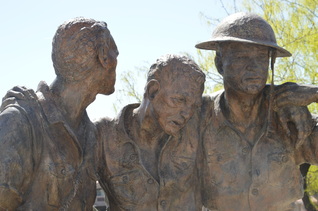
The three figures in the sculpture look in three different directions. One looks back to what they have already endured. One looks down, as if considering where they presently are. The third looks forward, to their future.

We had looked forward to the Bataan Memorial Death March for a long time. Our own journey began when one of the students on my track team heard from an Educational Assistant that I'd done it before. He asked if it was hard, and I answered that yes, it was, but it was possible for anyone who put in enough training. "So," he said, "when are we going to start training?"

How could I say no?

​We began hiking right after Thanksgiving. We hiked three to five miles on Mondays and Wednesdays after school, with longer hikes on Saturdays, eventually building up to twenty miles.
Picture
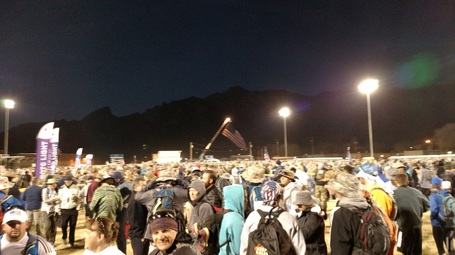
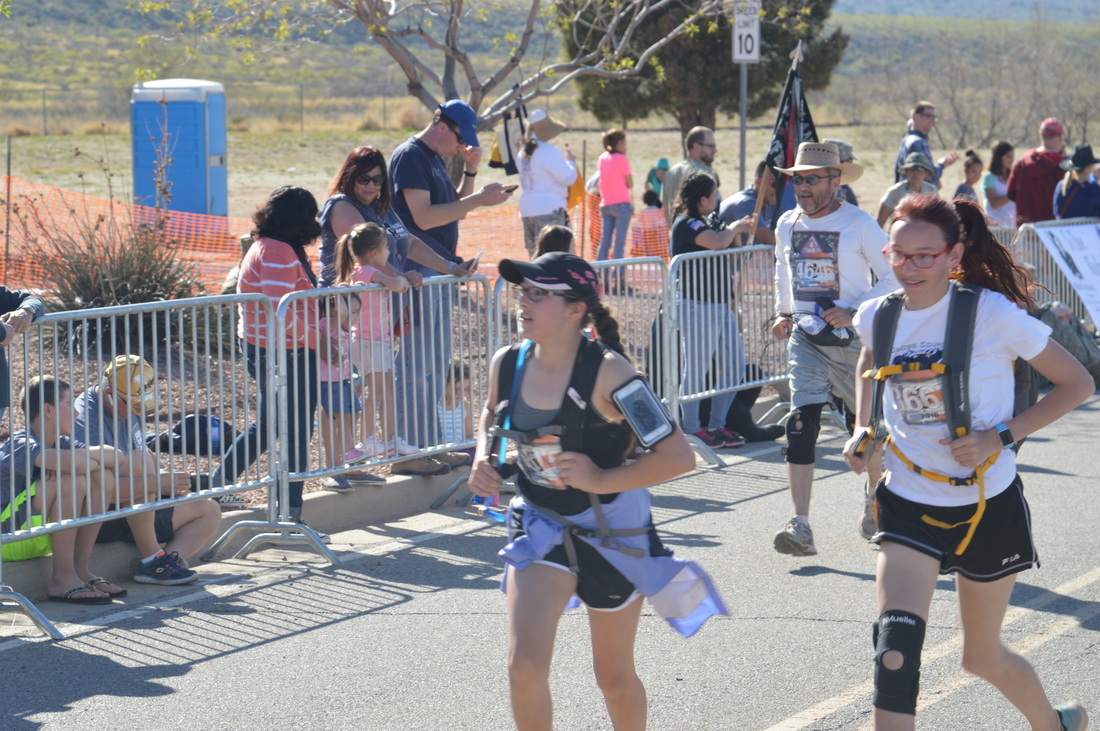
On the day of the march we gathered in the pre-dawn hours. After a stirring ceremonial and a chance to thank the few remaining survivors, we were off on our adventure.

Picture
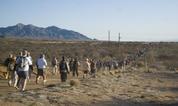
Some of us did the short course, which was a little over 14 miles, while others in our group completed the full 26.2 mile marathon. The course had a mix of dirt roads and pavement through the dry high desert of White Sands Missile Range, in southern New Mexico.

Picture
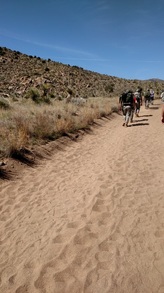
The portion of the route known as the Sand Pit was the hardest for most. Located in the last third, when we were already good and tired, the Sand Pit went right up a sandy arroyo. It was like walking on a beach.

A majority of the people who do The Bataan Memorial Death March are military and in uniform, so we were always surrounded by strong and supportive people. This is one of the things that makes this marathon very different from any other marathon: rather than being a competition, it is a day-long commemoration of the fighting spirit of our troops. We march to remember, and to challenge ourselves to be as tough as we can be.


Picture
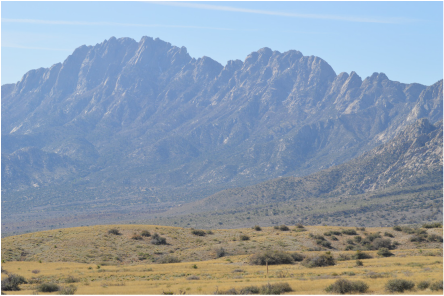
Despite the arid conditions, the desert is not without its beauty. The California poppies were in bloom and the beautiful Organ Mountains stood sentinel over our west flank.

Picture

Picture
Many thanks to Barbara Leiber- Klotz, who took the majority of these pictures.
I am proud to report that everyone finished strong, and with good times. Some have even started to talk about "next year." 

Mission Accomplished.

Tuesday, April 5, 2016

Spinach, New Mexican Style


Picture
When most people think of vegetables and side dishes in New Mexican cooking, they think about pinto beans and rice, and maybe a garnish of chopped lettuce and tomatoes.

Authentic New Mexican cooking offers more than a bit of chopped up salad.

Spinach is a wonderful spring tonic because it grows early, before the soil warms up, and more tender plants are still endangered by the Southwest's late freezes. Because of its hardiness, spinach is a needed dose of fresh greens after the long, hard winter.

I recently went to The Church Street Cafe, a wonderful restaurant tucked into a side street behind San Felipe Church in Albuquerque's Old Town. The cafe is in Casa de Ruiz, on property that has been in the Ruiz family since Albuquerque's founding in 1706. If you want an historical New Mexican experience, you can't get much more authentic than the food here, which includes quelites, Spanish for spinach, calabacitas, a wonderful medley of summer squash and corn, and old fashioned chili rellenos, which I've had in private homes but haven't seen offered in any other restaurant.  

When my novel set in New Mexico during the Civil War comes out, I plan to also offer a small cookbook with recipes from the period. The cookbook will have New Mexican recipes, plus some from the Gettysburg area to tie in with The Bent Reed. This one will be in that cookbook, but I'm offering it to you now, when we could all use a touch of spring tonic. Espero que te guste.

QUELITES (New Mexican Spinach)
Yield: 4-6 servings
Cooking Time: Approximately 15 minutes

Ingredients:
1 1/2 pounds washed fresh spinach 
1/4 teaspoon chile flakes (the kind you sprinkle on pizza)
1 tablespoon shortening
3 tablespoons chopped onion
1 tsp salt
2 slices of bacon 

Directions:
1. Wash spinach and remove stem ends.
2. Place spinach in a medium-sized saucepan and steam for 10 minutes at medium heat.
3. Drain and chop spinach. Set aside.
4. Sauté onion and bacon in a medium-sized saucepan at medium heat. Add spinach and remaining ingredients to onion, bacon and cook for an additional 5 minutes.
6. Sprinkle with chile flakes.

Wednesday, March 30, 2016

An interview with Stacy Barnett Mozer


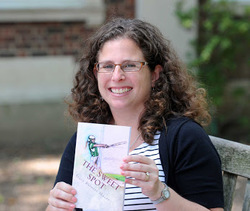
Know any athletic girls, ages 8-14 who want a good role model and a source of inspiration? I urge you to buy them copies of The Sweet Spot, by Stacy Mozer.
Picture
When thirteen-year-old Sam Barrette’s baseball coach tells her that her attitude's holding her back, she wants to hit him in the head with a line drive. Why shouldn’t she have an attitude? As the only girl playing in the 13U league, she’s had to listen to boys and people in the stands screaming things like “Go play softball,” all season, just because she’s a girl. Her coach barely lets her play, even though she’s one of the best hitters on the team.All stakes now rest on Sam’s performance at baseball training camp. But the moment she arrives, miscommunication sets the week up for potential disaster. Placed at the bottom with the weaker players, she will have to work her way up to A league, not just to show Coach that she can be the best team player possible, but to prove to herself that she can hold a bat with the All-Star boys.

Picturephoto courtesy The Greenwich Time
I caught up with author Stacy Mozer recently and got to ask her about The Sweet Spot, her book recently published by Spellbound River Press.

Stacy is a third grade teacher and a mom. She started writing books when a class of students told her that there was no way that a real author who wrote real books could possibly revise their work as much as she asked them to revise. She proved them wrong and has been revising her own work ever since. 


Me: Why does your main character want to play baseball? Why not softball?

Stacy: 
Sam plays baseball because I grew up as a Mets fan and a baseball lover. My favorite movie growing up was Blue Skies Again, a story about a girl who gets on to a minor league team. Softball is a great sport, but it isn’t the same as baseball. The pitching is different, the fielding is different. And just because you are good at one sport it, doesn’t mean that you are good at the other. When I was doing research I played around with the idea that Sam was at a camp and forced to play softball so she convinced a bunch of girls to form their own baseball team. The expert that I spoke to said it would never work because when she was in high school she convinced a number of her softball friends to try out for baseball. She was the only one who made the team.

Me: Is Sam’s character based on a real person, a composite of people, or is she completely fictitious?

Stacy: 
Sam is a composite of girls I’ve had in my class over the years who have fought their way on the playing field with the boys at recess. She also has some of me in her too. Her snarkiness is definitely me.

Me: Have you got another book in the pipeline?

Stacy: Book 2 will be coming out from Spellbound River this time next year. It’s call The Perfect Trip and it tells the story of the rest of Sam’s summer and new obstacles she will face in her baseball career. 

Friday, March 25, 2016

Play ball, girls!


Not all girls want to play the sports usually reserved for them. Unfortunately, girls face a lot of resistance breaking into sports that are traditionally in the males' domain. While this resistance might not be fun for girls who face it, it makes for great middle grade reading.

Spring is here, and the metallic ping of aluminum bats hitting baseballs rings through the land. Most of those bats are swung by boys, but there are some girls who'd rather hit a hard ball than a softball.

Picture
The Sweet Spot, Stacy Barnett Mozer, is a great book for athletic middle school and upper elementary girls. Thirteen-year-old Sam Barrette’s baseball coach tells her that her attitude's holding her back, but how can she not have an attitude when she has to listen to boys and people in the stands screaming things like “Go play softball,” all season, just because she's the only girl playing in the 13U league. Lovely and sensitive, this book will help guide girls through the difficulties of asserting themselves and becoming leaders in a man's world.


The Sweet Spot comes out in a new edition published by Spellbound River today. I'll be interviewing the author on this blog next week. If this book appeals to you, enter a giveaway at Rafflecopter.


Picture
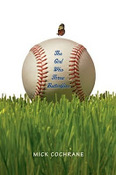
The Girl Who Threw Butterflies, by Mick Cochrane, is another book about a girl trying to play baseball. After her father's death in a car accident, eighth grader, Molly Williams decides to join the baseball team and show off the knuckleball her father taught her how to throw. Although the author does a little more telling than showing, this book also gives a fair picture of a girl overcoming hardships, both on the field and in her personal life.

Picture
And, just because not every girl wants to play baseball, I'm including Dairy Queen by Catherine Gilbert Murdock. This novel tells the story of fifteen-year-old D. J. Schwenk, the only daughter of a farmer in Red Bend, Wisconsin who loves football so much that he names his cows after football players. D.J. knows a lot about football because of her brothers, but when she decides that she wants to join the team, the opposition nearly sacks her courage

 Let us hope that the opposition to girls in male dominated sports truly becomes an historical issue soon.

Tuesday, March 15, 2016

In the Footsteps of heroes


Picture
​When New Mexico’s National Guard 200th and 515th Coast Artillery landed in the Philippines in the early 1940s, they thought they’d landed in paradise. Coming from an arid, landlocked state, few had ever seen beaches or tropical forests. Little did they know that it would soon become hell on earth. 

On the day after Japan bombed the U.S. naval base at Pearl Harbor, December 7, 1941, the Japanese invaded the Philippines. They captured the capital, Manila, in less than a month. American and Filipino defenders retreated onto the Bataan Peninsula, where they held out for three months despite dwindling supplies of food, medicine and ammunition and no support or resupply by naval or air forces. By April 9, starvation and disease had become so crippled the troops that the force of approximately 75,000 surrendered.

​The Japanese rounded up the surrendered soldiers and forced them to march some 65 miles in what became known as the Bataan Death March. The men, divided into groups of approximately 100, typically took around five days to march from the southern end of the Bataan Peninsula, to San Fernando where they were loaded in to cattle cars to complete the journey to prisoner-of-war camps. Exact figures are unknown, but it is believed that thousands of troops died because of the brutality of their captors, who starved and beat the marchers, and bayoneted those too weak to walk. More than 1,400 of those involved in the march were New Mexicans. 
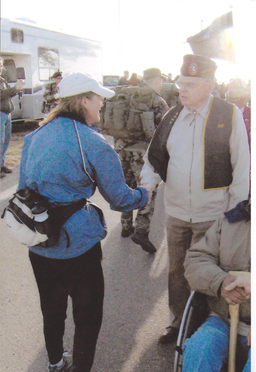
PictureShaking the hand of Bataan survivor William Overmeier, 2007
The Bataan Memorial Death March is a commemoration held every spring at White Sands Missile Range in Southern New Mexico. Marchers, many of whom are members of the military, complete either the 26.2-mile or the 14.2 mile course. Some carry heavy packs. All do it to honor those involved in the original march. Although their numbers are dwindling, some survivors attend this event. Now in their 90s, time is accomplishing what their Japanese captors could not. 

I have done the march five times before: twice completing the short course and three times completing the long. I've accompanied friends, family members, Boy Scouts, and members of Team RWB, an organization that uses exercise and social activities to help veterans reintegrate into civilian life. This year the march is on March 20. This time I have trained and am leading ten others, including four 8th graders, their parents, and other staff members from the middle school at which I work. Five of us are doing the full course. Another six (including me) will complete the short course. 

​I’ll let you know how it goes.

Keeping Time with the Romans

  Modern societies rely on precise and standardized timing. Our schedules are synchronized to prevent chaos, ensure safety, and keep complex...