Monday, June 26, 2017

Magical History Tour


Thursday, April 13, 2017

Unusual responses


I've been writing a blog for about three years now. Most of the time I feel like I'm writing to myself. I don't get a lot of comments posted. When I do, I'm grateful. I appreciate it when someone learns something from my blog. I especially appreciate it when I'm told that one of my posts made a reader think about something they'd never thought of before.

But sometimes the comments that get posted really make me scratch my head and wonder who is reading my blog and why.


This week someone called topqualityessays posted a comment regarding my post Paddy Graydon Scheme to Stop the Confederacy that said "Thin air is the blog about the writer create this because of their books history to save their record on the line. First of all this a good decision for their online record saved books where we can search now on the system to develop our environment and the new technology of generation."  Also this week, theconfidentopywriter commented on Americans in Paris, saying "Embarrassingly clumsy up to your post and sit tight for your next posts.Request Comcast has an extraordinary plan and great design. I have seen few pictures that have such incredible hues."

Huh?

When I first got comments like this, I got panicky, thinking they were some sort of cyber attack or spam. Now I wonder if someone in a third world country is using my blog to practice their English. I'm not sure if I'll ever know.

Saturday, April 8, 2017

Potato Bread


The nineteenth century was a thriftier time than the present. Nothing was thrown away and everything, even the water that potatoes were boiled in, was put to good use. Potato water was used to starch shirts, fertilize plants, thicken gravies, and supplement bread.

This recipe is adapted from one in James Beard's Beard on Bread, a cookbook which has seen a lot of use in my house over the years. Mr. Beard noted that this bread, with its moist and heavy texture, is reminiscent of breads from the nineteenth century. I don't know if Ms. McCoombs, the mother in The Bent Reed, my novel set during the Battle of Gettysburg, would have made this bread, but if she did, she would have started with a home-grown yeast and her loaves would have risen not in the refrigerator, but in the root cellar.

You can make up the dough on Saturday, and have a warm loaf all ready for Sunday supper.

Old Fashioned Potato Bread
Dissolve 1 pkg active dry yeast and 1/2 cup sugar in 1 1/2 cups warm potato water. Let proof for about 5 minutes.

Add 3/4 cup of softened butter,  1 1/2 TBS salt, 2 eggs, and mix well.

Add 1 cup leftover mashed potatoes and mix well.

Add up to 6 cups of flour. Stir it in, 1 cup at a time until you can no longer stir it, then turn out the dough onto the counter and knead it, adding flour whenever it becomes sticky. When the dough is smooth and elastic, place it in a very large mixing bowl or storage container that has been buttered and turn to coat all sides with the butter. Cover tightly and let rise in the refrigerator overnight. You want to use a very large container: this bread will more than double in size.

When you are ready to bake, remove from refrigerator and punch down. Knead on a floured counter for 5 minutes, then shape into two loaves. Place in well buttered bread pans and let rise until doubled in size. Because this bread was cooked, this may take up to 4 hours.

Bake 40-45 minutes in an oven set at 375. To test if they are done, turn a loaf out of its pan and rap the bottom. If you hear a hollow sound, the loaves are cooked through. Turn the oven off, turn the loaves out, and set them directly on the oven rack, where their crusts will crisp and brown.  Cool completely before slicing.

Thursday, April 6, 2017

A short history of yeast


Bread wasn’t always as easy to bake as it is now. Bread gets its airy structure by capturing gas bubbles in the elastic gluten of wheat. But how does one get those gas bubbles into the dough to begin with? The answer is leavening.

Throughout history, most households kept a crock of leavening in a warm corner of their kitchen. A small portion of this soft, dough-like substance was used to start each new lot of bread dough. The rest was replenished with water and flour and kept, sometimes for generations.

If a housewife neglected her leavening, it might cease to rise and turn into a vile smelling, pink slime. In that case, she threw it out and either borrowed a bit of leavening from a neighbor or began a new batch by setting out a crock of water mixed with flour and hoping that it would begin to produce foam. Some women knew that adding the husks of stone ground wheat would often hasten the process.

Leavening was used in bread and cake batters. Often, a dose of beer or wine dregs was also added.

What those housewives had been collecting and tending in their flour and water filled crocks were living organisms, wild yeasts that lived in the air, but settled into the crocks and multiplied, eating the starch and expelling carbon dioxide. Wild yeasts were also present in the wheat husks and beer and wine dregs.

It wasn’t until the late 1860s, when Louis Pasteur placed some leavening under a microscope, that anyone realized this.

Shortly after that, scientists began to isolate yeast in pure culture form. By the turn of the 20th century, they had created a way to dry it, thereby forcing it into dormancy. No longer did housewives need to replenish the leavening crock every few days!

Commercial baker’s yeast much like what you buy in red and yellow packets or glass jars in the supermarket soon followed.
 
Tomorrow, look at my blog for a recipe for an old fashioned bread that uses new fangled commercial yeast.


Thursday, March 23, 2017

the life of a civil war soldier


Picture
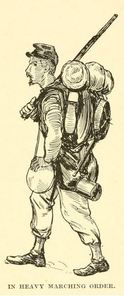
If you are curious about what it was like to be a soldier during the Civil War, there's no better place to start than John D. Billings' memoir, Hard Tack and Coffee. Historian Henry Steele Commager calls it "one of the most entertaining of all civil war books."

Subtitled The Unwritten Story of Army Life, this book was published in 1887 by Billings, who served in the 10th Massachusetts Volunteer Light Artillery Battery under General Sickles and General Hancock. It is not a history of the war, and doesn't talk about battles and strategy. Instead, it explains what it was like to enlist in the Union Army, how soldiers managed the every day acts of eating and sleeping, of punishments and pastimes, and what it was like to keep the Army on the move.

Picture
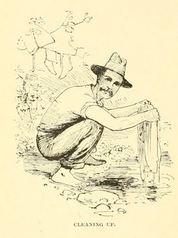
While some of the information in Billings' account is specific to his experiences in the Army of the Potomac, most of it would be useful for anyone who wanted to know about the life of the average soldier. Where else would we learn that troops camped near brooks washed their clothes in the running water until they realized that boiling them got rid of wood ticks and lice much better. To kill vermin, soldiers boiled their clothes in the mess kettles that also cooked their stews and boiled their coffee.
Picture
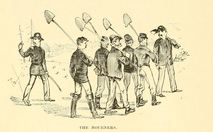
The writing is witty and the humor wry, the more than 200 pen and ink drawings are what really make Hard Tack and Coffee a treasure. The illustrations were created by another Civil War Veteran, Charles Reed, who served as bugler in the 9th Massachusetts Battery. Reed was awarded the Medal of Honor for saving the life of his battery commander at Gettysburg.
Picture
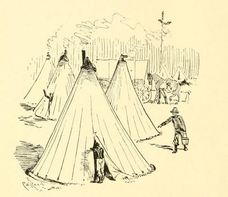
Reed shows the reader what a Sibley tent looked like. Invented by the man who left the Union Army to become a Brigadier General in the Confederacy, Sibley tents were used by both the North and the South. They resembled the teepees that Sibley would have seen while fighting Indians on the great plains and in New Mexico Territory, which Sibley invaded in 1862 in an attempt to conquer it for the South. One of my favorite pictures shows an interior view of a Sibley tent, and how the soldiers "spooned," or slept nested against each other in an attempt to keep warm.

General Sibley is a background character in Where Duty Calls and The Famished Country, books 1 and 3 of Rebels Along the Rio Grande, my historical novel trilogy about New Mexico during the Civil War. Reed's illustrations are now part of the public domain. 

Thursday, March 9, 2017

Paddy Graydon's Scheme to Stop the confederacy


Wednesday, March 1, 2017

Manuel Armijo: New Mexican Hero?


Keeping Time with the Romans

  Modern societies rely on precise and standardized timing. Our schedules are synchronized to prevent chaos, ensure safety, and keep complex...