My critique partners can attest that sometimes I don't remember my own books. They've been through so many revisions that I can't remember what's in them and what's been expunged.
I forget sub-plots. I can't remember characters' names. Often I've forgotten whole scenes.
This became a bit of a problem for me this past week. I'd had the honor of being asked to guest-write a post on Project Mayhem, a fabulous blog on writing hosted by a wonderful group of Middle Grade authors. I decided to address how little historical details can help readers grasp what a period of time was like, and how even the littlest of details could lead to some big questions. As an example, I decided to use a quirky little historical detail from my Civil War novel, The Bent Reed, which will be published in both paperback and ebook in September.
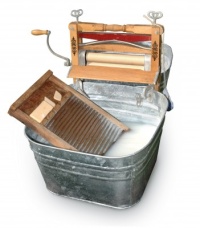
The quirky little historical detail in question is from a laundry scene; After washing Pa and Lijah's shirts, Ma dips them into a vat that contains the water left over from boiling potatoes. Why would she do this, you ask? Because the left-over potato water would have had starch suspended in it, and the starch would have made ironing the shirts easier, and the ironed shirts more crisp.
I remember learning this little historical detail in a Civil War era book of hints for housewives and being fascinated. I delight in little bits of trivia like this. I thought that it could lead to many interesting discussions about resource use and thriftiness.
As I wrote my post last week, I decided that this detail was a perfect example of how little bits of trivial information about everyday life in an historical period could not only bring that period to life for readers, but help readers ask big questions about how history informs the present day. And so I pulled out my manuscript and began searching for the scene.
And this is where I ran into a problem, because the scene wasn't there. I searched using potato and starch and laundry as key words. I found several scenes with laundry, but none involved a vat of potato water or even an iron.
Apparently, at some point in my rewriting and revision process I had cut this beloved little bit of trivia from my story and then forgotten about doing so.
Thinking about it now, I'm not surprised that I'd thrown out the vat of potato water. Even the most interesting bits of historical trivia have to either move the plot along or illuminate the characters. Although I cannot remember thinking so, I must have decided at some point that the potato water did neither.
Now that I think of it, I'm convinced that using the water left over from boiling potatoes show just how frugal Ma was. Like most women in her era, she used a good deal of her own elbow grease and determination to make sure to turn everything to good account.
Maybe I threw out the baby with the potato water.
I forget sub-plots. I can't remember characters' names. Often I've forgotten whole scenes.
This became a bit of a problem for me this past week. I'd had the honor of being asked to guest-write a post on Project Mayhem, a fabulous blog on writing hosted by a wonderful group of Middle Grade authors. I decided to address how little historical details can help readers grasp what a period of time was like, and how even the littlest of details could lead to some big questions. As an example, I decided to use a quirky little historical detail from my Civil War novel, The Bent Reed, which will be published in both paperback and ebook in September.
The quirky little historical detail in question is from a laundry scene; After washing Pa and Lijah's shirts, Ma dips them into a vat that contains the water left over from boiling potatoes. Why would she do this, you ask? Because the left-over potato water would have had starch suspended in it, and the starch would have made ironing the shirts easier, and the ironed shirts more crisp.
I remember learning this little historical detail in a Civil War era book of hints for housewives and being fascinated. I delight in little bits of trivia like this. I thought that it could lead to many interesting discussions about resource use and thriftiness.
As I wrote my post last week, I decided that this detail was a perfect example of how little bits of trivial information about everyday life in an historical period could not only bring that period to life for readers, but help readers ask big questions about how history informs the present day. And so I pulled out my manuscript and began searching for the scene.
And this is where I ran into a problem, because the scene wasn't there. I searched using potato and starch and laundry as key words. I found several scenes with laundry, but none involved a vat of potato water or even an iron.
Apparently, at some point in my rewriting and revision process I had cut this beloved little bit of trivia from my story and then forgotten about doing so.
Thinking about it now, I'm not surprised that I'd thrown out the vat of potato water. Even the most interesting bits of historical trivia have to either move the plot along or illuminate the characters. Although I cannot remember thinking so, I must have decided at some point that the potato water did neither.
Now that I think of it, I'm convinced that using the water left over from boiling potatoes show just how frugal Ma was. Like most women in her era, she used a good deal of her own elbow grease and determination to make sure to turn everything to good account.
Maybe I threw out the baby with the potato water.

Jennifer Bohnhoff is an educator and writer who lives in New Mexico. She has written two novels set in the Civil War: The Bent Reed, which takes place at Gettysburg, and Valverde, set in New Mexico. The sequel to Valverde, Glorieta, will be published this spring. This post was originally published July 14, 2014.
2025 note: Valverde was republished by Artemesia Publishing under the title Where Duty Calls, Glorieta under the title The Worst Enemy. The third in the series, The Famished Country, was published in 2024.