
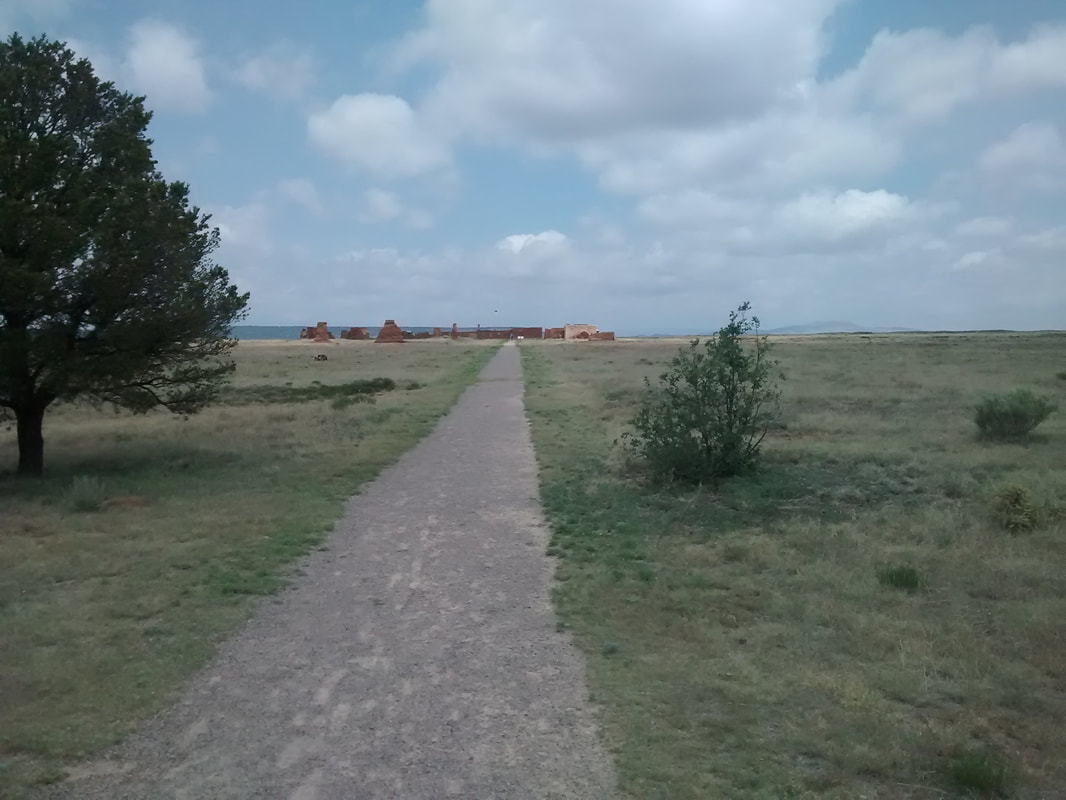
 The ruins of the third Fort Union. 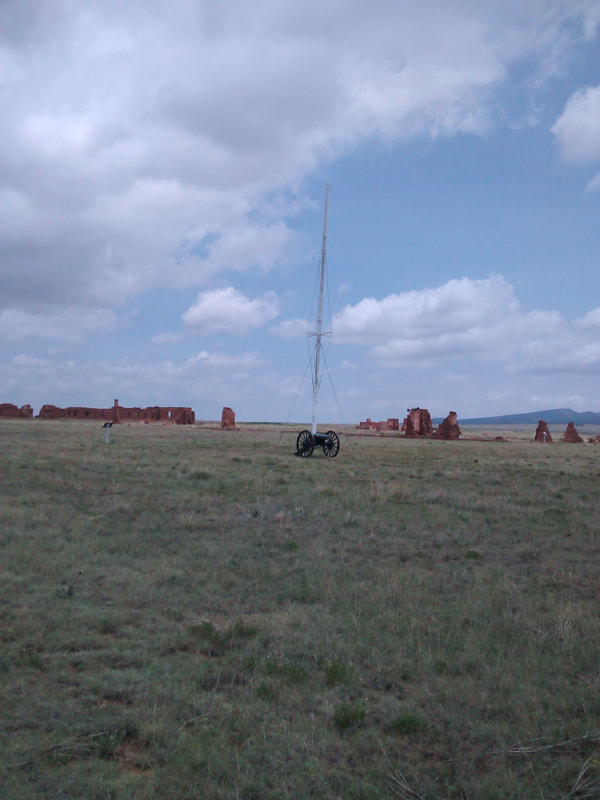 | Fort Union rests out in the middle of nowhere, but a century and a half ago it was the center of a lot of activity. It has been rebuilt three times, each time responding to what was happening around it. Located near the convergence of the Mountain and Cimmaron branches, Fort Union's original task was to monitor the Santa Fe trail. The soldiers were charged with controlling Native Americans and, if wagon trains came under attack, to respond with campaigns against the Indians. The original fort, constructed in the 1850s, was built close by the eastern edge of a high mesa in order to protect it from the incessant winds. Diaries from the period indicate that the protection was minimal, and that sand constantly seeped through cracks around windows and found its way into beds and food supplies. |
It was thrown up quickly, and made of adobe and logs that were already in serious disrepair a decade later, when the Civil War began to disrupt life in the territory.
By August 1861, the Confederates under John Baylor had already claimed the southern half of New Mexico Territory and renamed it Arizona. The U.S. Army was convinced that invasion of Northern New Mexico was imminent, and that Fort Union was the key to holding the territory. However, the bluffs that protected it from wind also made it vulnerable to cannon fire should the Confederates be able to take them. A new fort was needed.
By August 1861, the Confederates under John Baylor had already claimed the southern half of New Mexico Territory and renamed it Arizona. The U.S. Army was convinced that invasion of Northern New Mexico was imminent, and that Fort Union was the key to holding the territory. However, the bluffs that protected it from wind also made it vulnerable to cannon fire should the Confederates be able to take them. A new fort was needed.
The Second Fort Union was built a mile and a half away from the first, in the open valley. Its earthwork walls, parapets, and moats covered 23 acres and were shaped like a star to accommodate 28 cannon. It was built by Hispanic | 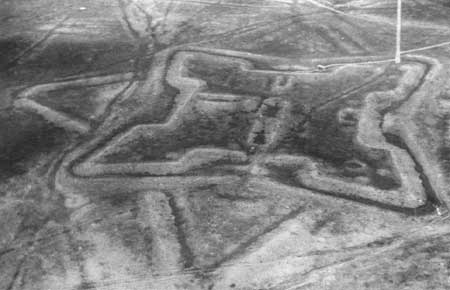 |
Volunteers since most of the Union Troops had been called east. The work went on 24 hours a day, with gangs of 200 men taking four hour shifts. The fort was ready by February 1862, when Confederates advanced up the Rio Grande and defeated the Union forces at the battle of Valverde. By March they had taken Albuquerque and then Santa Fe. It seemed that Fort Union was the only thing standing between the Confederates and the rich gold fields of Colorado.
Colonel Edward Canby, the Commander of Union forces in New Mexico Territory, said "The question is not of saving this post, but of saving New Mexico and defeating the Confederates in such a way that an invasion of this Territory will never again be attempted. It is essential to the general plan that this post should be retains if possible. Fort Union must be held."
The standoff at Fort Union never happened. No one on either side anticipated the gritty determination of the Colorado Volunteers when they refused to stay at the fort, and instead confronted the enemy in the mountains east of Santa Fe.
Colonel Edward Canby, the Commander of Union forces in New Mexico Territory, said "The question is not of saving this post, but of saving New Mexico and defeating the Confederates in such a way that an invasion of this Territory will never again be attempted. It is essential to the general plan that this post should be retains if possible. Fort Union must be held."
The standoff at Fort Union never happened. No one on either side anticipated the gritty determination of the Colorado Volunteers when they refused to stay at the fort, and instead confronted the enemy in the mountains east of Santa Fe.
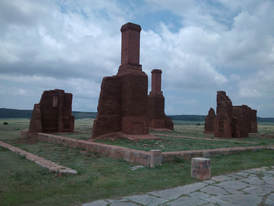 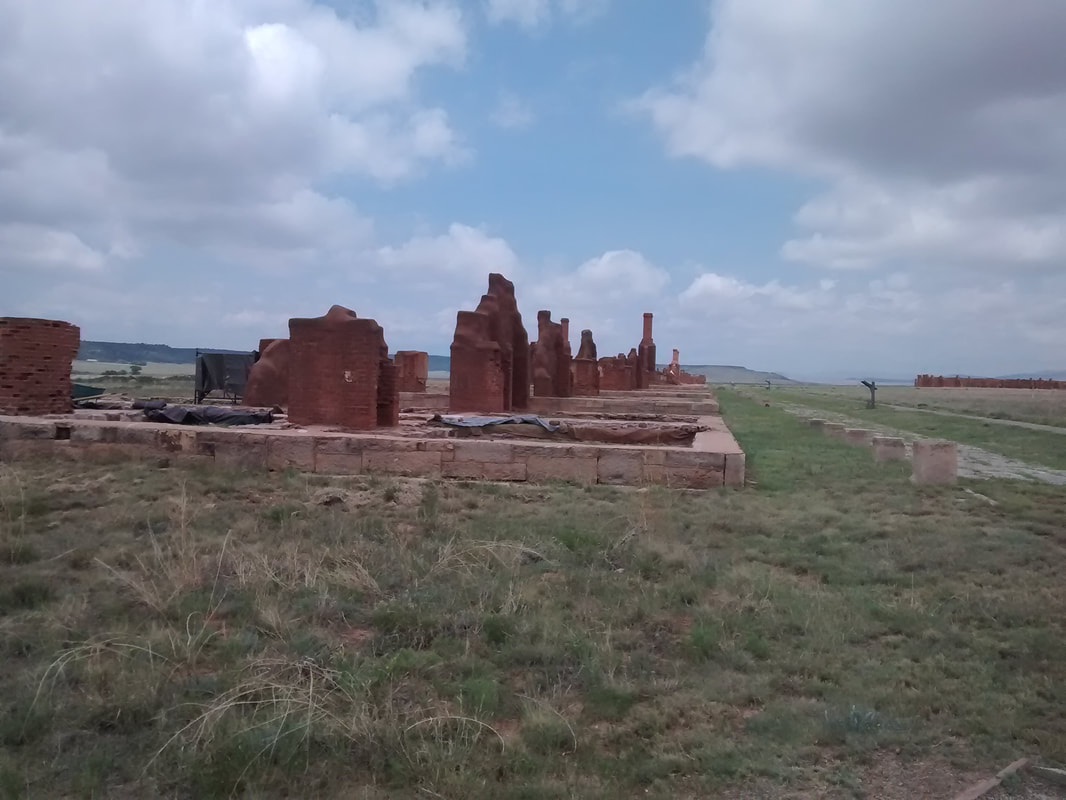 | When visitors go to Fort Union National Monument, most of what they see is the remains of the third fort. Begun in 1863, this fort became the largest military outpost west of the Mississippi River. It served as an arsenal and depot, and was a safe resting place for travelers along the Santa Fe Trail. Again, its primary function was controlling the Indians and protecting Americans who used the trail. The military abandoned the fort in 1891. By then the Apaches and Comanche had been subdued and the railroad had entered the state, effectively ending the |
era of the Santa Fe trail. When I toured it in June 2017, there were few people there. I was able to walk among the ruins and read the interpretive signs without jostling crowds. The occasional sound of a bugle call broke the constant rush of the winds through the ruins. It was peaceful and pleasant, and I learned a lot from the small museum situated near the parking lot.
The fort is located 28 miles north of Las Vegas, New Mexico. To get there, take exit 366 off I-25 and go 8 miles north and west. The park, which is run by the National Park Service, is open from 8-5 from Memorial Day to Labor Day, and 8-4 the rest of the year. Check their website for special programs and tours.
The fort is located 28 miles north of Las Vegas, New Mexico. To get there, take exit 366 off I-25 and go 8 miles north and west. The park, which is run by the National Park Service, is open from 8-5 from Memorial Day to Labor Day, and 8-4 the rest of the year. Check their website for special programs and tours.

Jennifer Bohnhoff is a writer, historian, and novelist who lives in the mountains east of Albuquerque, New Mexico.
This article was originally published on July 22, 2017. This fort is one of the places depicted in The Worst Enemy, the second in a trilogy about the Civil War in New Mexico, which will be published this spring.
This article was originally published on July 22, 2017. This fort is one of the places depicted in The Worst Enemy, the second in a trilogy about the Civil War in New Mexico, which will be published this spring.


No comments:
Post a Comment