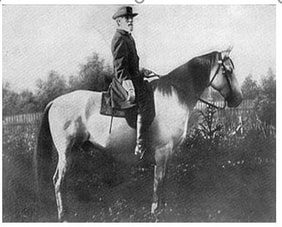
 This Photo by Unknown Author is licensed under CC BY-SA
Horses served an important role in the Civil War, and suffered as greatly as the men beneath them. It has been estimated that 1.5 million horses and mules died in the Civil War. Five million pounds of dead horses was removed from the Gettysburg battlefield alone. But of all the horses that served in this period, none is as famous as Traveller.
Traveller, spelled as the British do, with two Ls, was an iron grey American Saddlebred with black points and a dark mane and tail. The 16-hand tall horse was sired by a race horse named Grey Eagle, who had won $20,000 in a Louisville, Kentucky stake race, and born in 1857 in Greenbrier County, in what is now West Virginia. His first owner named him “Jeff Davis,” after the Mississippi Senator and Mexican American War hero who eventually became the President of the Confederacy.
In 1861 the son of the original owner took the horse with him when he joined the legion of former Virginia governor Brig. Gen. Henry Wise. He sold the horse to Captain Joseph M. Broun, a quartermaster of Wise’s Legion’s 3rd Infantry. Broun renamed the horse “Greenbriar.” When Robert E. Lee arrived to advise Wise in late August 1861, he saw Broun’s horse and was immediately taken with him, calling the horse ‘my colt’ and saying he would need it before the war was over. Aware of the difference in their ranks, Broun offered to give the horse to Lee, who declined the offer. Broun then offered to sell Greenbriar to Lee for the same price he had himself paid for the horse. Lee added an extra $15 to cover the depreciating value of the Confederate dollar. Lee bought the horse in February 1862 and renamed him Traveller because of his ability to walk at a fast pace.
Although Traveller was not the only horse Lee rode from that time on, it was the one he rode and most and the one that became linked to him in the public’s eye. He was known for great endurance during long marches, and being unflappable in battle. He was not perfect, though. Lee’s youngest son, Robert E. Lee Jr later wrote that the horse fretted a lot, especially when in crowds if he wasn’t regularly exercised. At the Second Battle of Manassas he shied at enemy movements, rearing and throwing the General, who broke bones in both his hands during the fall.
Traveller, spelled as the British do, with two Ls, was an iron grey American Saddlebred with black points and a dark mane and tail. The 16-hand tall horse was sired by a race horse named Grey Eagle, who had won $20,000 in a Louisville, Kentucky stake race, and born in 1857 in Greenbrier County, in what is now West Virginia. His first owner named him “Jeff Davis,” after the Mississippi Senator and Mexican American War hero who eventually became the President of the Confederacy.
In 1861 the son of the original owner took the horse with him when he joined the legion of former Virginia governor Brig. Gen. Henry Wise. He sold the horse to Captain Joseph M. Broun, a quartermaster of Wise’s Legion’s 3rd Infantry. Broun renamed the horse “Greenbriar.” When Robert E. Lee arrived to advise Wise in late August 1861, he saw Broun’s horse and was immediately taken with him, calling the horse ‘my colt’ and saying he would need it before the war was over. Aware of the difference in their ranks, Broun offered to give the horse to Lee, who declined the offer. Broun then offered to sell Greenbriar to Lee for the same price he had himself paid for the horse. Lee added an extra $15 to cover the depreciating value of the Confederate dollar. Lee bought the horse in February 1862 and renamed him Traveller because of his ability to walk at a fast pace.
Although Traveller was not the only horse Lee rode from that time on, it was the one he rode and most and the one that became linked to him in the public’s eye. He was known for great endurance during long marches, and being unflappable in battle. He was not perfect, though. Lee’s youngest son, Robert E. Lee Jr later wrote that the horse fretted a lot, especially when in crowds if he wasn’t regularly exercised. At the Second Battle of Manassas he shied at enemy movements, rearing and throwing the General, who broke bones in both his hands during the fall.
After the war, Lee continued to keep the grey near him. He brought Traveller to Washington University when he became its president, and the pair were a common site on campus. Traveller became such a celebrity that his mane and tail thinned because students plucked the dark hairs as souvenirs. Locks of Lee’s hair and Traveller’s mane are still part of the collection at Arlington House, Lee’s former home on the grounds of Arlington National Cemetery.
When Lee died in October of 1870, Traveller was draped in black crepe walked, riderless, behind the funeral hearse. Less than a year later, Traveller stepped on a nail and contracted tetanus. He died June of 1871 and was buried along a creek adjoining Washington University’s campus near Lee Chapel.
But Traveller’s story didn’t end with his death. In 1875, Custis Lee, who had succeeded his father as President of the institution that was renamed Washington and Lee University after the General’s death, exhumed Traveller and sent his bones to Henry Augustus Ward, a University of Rochester faculty member who traveled the world acquiring a massive assortment of geological and zoological specimens and taxidermy samples for museums.
When Lee died in October of 1870, Traveller was draped in black crepe walked, riderless, behind the funeral hearse. Less than a year later, Traveller stepped on a nail and contracted tetanus. He died June of 1871 and was buried along a creek adjoining Washington University’s campus near Lee Chapel.
But Traveller’s story didn’t end with his death. In 1875, Custis Lee, who had succeeded his father as President of the institution that was renamed Washington and Lee University after the General’s death, exhumed Traveller and sent his bones to Henry Augustus Ward, a University of Rochester faculty member who traveled the world acquiring a massive assortment of geological and zoological specimens and taxidermy samples for museums.
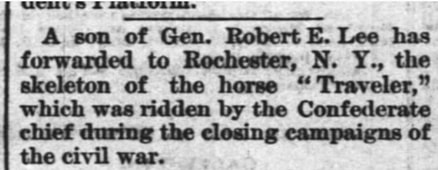
CLIPPED FROM The Times-Picayune New Orleans, Louisiana 15 Dec 1875, Wed
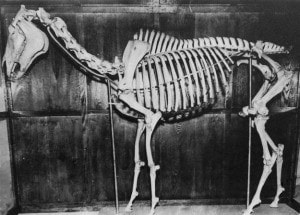 An undated image of Traveller’s skeleton on display in Lexington.
The skeleton was returned to Washington and Lee in 1907, and later moved to the basement of Lee Chapel. By the time his bones were reburied in front of the chapel in 1960, the bones had deteriorated and were covered with the penned signatures of visitors.