
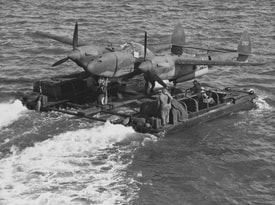
 Two DUKWs carrying a P-38. (Photo: Worldwarphotos.info)
After World War II had ended, General Dwight Eisenhower wrote that while most of his senior officers considered the bulldozer, the Jeep, the 2,5-ton truck, and the C-47 airplane the four most vital pieces of military equipment to the Allies’ success, he thought that the DUKW was “one of the most valuable pieces of equipment produced by the United States during the war.” (Philip Handleman, and Walter J. Boyne, editors: Brassey’s Air Combat Reader, pg. 255). Not everyone shared Ike’s enthusiasm for the amphibious vehicles commonly called ‘ducks.” Their less than stellar performance during the D-Day invasion made many suspicious of them.
DUKW, which comes from the model-naming terminology used by GMC, is an acronym for the fact that it was “D,” designed in 1942, “U,” a utility vehicle that was “K,” all-wheel drive, with “W,” two rear axles. Soldiers, who had nicknames for everything, first called them Ducks. The vehicle was developed in only 38 days through a collaboration between yacht designers Sparkman & Stephens and General Motors. It had a 104 horsepower Chevy engine which was able to reach 50 mph on land and 6 mph on water. They were 31 feet long, 8 feet wide, and 7 feet high. A quarter of the 21,000+ DUKWs that were manufactured between 1942 and 1945 had .50 caliber Browning machine guns ring-mounted to them.
DUKW, which comes from the model-naming terminology used by GMC, is an acronym for the fact that it was “D,” designed in 1942, “U,” a utility vehicle that was “K,” all-wheel drive, with “W,” two rear axles. Soldiers, who had nicknames for everything, first called them Ducks. The vehicle was developed in only 38 days through a collaboration between yacht designers Sparkman & Stephens and General Motors. It had a 104 horsepower Chevy engine which was able to reach 50 mph on land and 6 mph on water. They were 31 feet long, 8 feet wide, and 7 feet high. A quarter of the 21,000+ DUKWs that were manufactured between 1942 and 1945 had .50 caliber Browning machine guns ring-mounted to them.
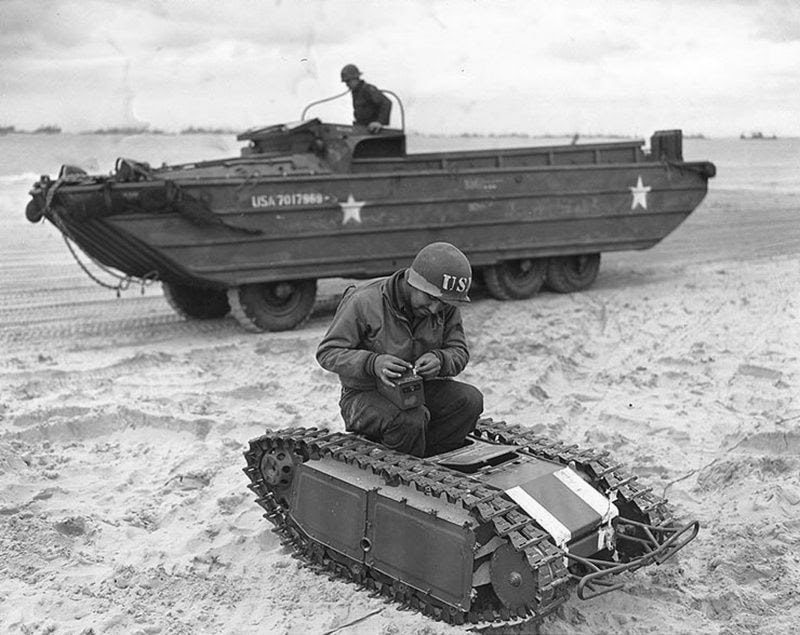 A DUKW at Utah Beach. In front, a soldier inspects a German Goliath tracked mine. (Photo: world-war-2.wikia.org)
DUKWs, which were able to carry a payload of 2.5 tons, or around 20 troops with all their equipment, were originally designed to allow the military to drop cargo off where there were no ports at which to dock supply ships. It was the first vehicle to come equipped with a Speir's Device, a central tire inflation system which allowed drivers to vary the tire pressure to adapt to different surfaces. Fully inflated tires were good for hard surfaces such as roads, while softer tires gave better grip on beach sand.
The Army was not impressed with its design at first, and rejected them. However, when a Coast Guard patrol craft ran aground on a sand bar during a storm near Provincetown, Massachusetts, a prototype DUKW that was being tested nearby was able to save the patrol craft’s crew. The Army, now aware of the craft’s versatility, changed its mind. By March 1943, they were successfully being used in Guadalcanal in the South Pacific. They were also used to great effect in Operation Husky, the 1943 invasion of Sicily. In addition to their normal transport duties, DUKWs were used as naval ambulances and for providing fire support to landing troops.
Opinions on DUKWs changed after their failure during the D-Day Invasion, where all but one of the vehicles being used to haul howitzers to Omaha Beach sank shortly after debarking from their carriers. This wasn’t a failure of the vehicle so much as a failure of command to understand the DUKW’s limitations. In good weather, DUKWs perform well. In bad weather, especially in high waves and when loaded with heavy cargo such as howitzers, they are not seaworthy.
The Army was not impressed with its design at first, and rejected them. However, when a Coast Guard patrol craft ran aground on a sand bar during a storm near Provincetown, Massachusetts, a prototype DUKW that was being tested nearby was able to save the patrol craft’s crew. The Army, now aware of the craft’s versatility, changed its mind. By March 1943, they were successfully being used in Guadalcanal in the South Pacific. They were also used to great effect in Operation Husky, the 1943 invasion of Sicily. In addition to their normal transport duties, DUKWs were used as naval ambulances and for providing fire support to landing troops.
Opinions on DUKWs changed after their failure during the D-Day Invasion, where all but one of the vehicles being used to haul howitzers to Omaha Beach sank shortly after debarking from their carriers. This wasn’t a failure of the vehicle so much as a failure of command to understand the DUKW’s limitations. In good weather, DUKWs perform well. In bad weather, especially in high waves and when loaded with heavy cargo such as howitzers, they are not seaworthy.
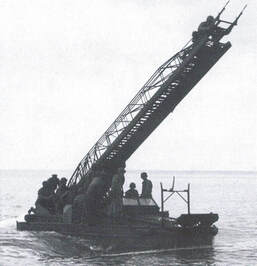 The specially modified DUKW with an extension ladder used at Pointe du Hoc (Photo: Mikesresearch.com)
Not all DUKWs performed badly, even on the choppy waters of the Norman Coast. U.S. Rangers used specially modified DUKWs with 100foot extension ladders to climb the steep cliffs of Pointe du Hoc to take out the German gun emplacements there.
Most DUKWs were decommissioned after World War II. A few hundred went to the Korean War and to Vietnam, while others were distributed to police and civilian search-and-rescue units, where they continue to serve.
Most DUKWs were decommissioned after World War II. A few hundred went to the Korean War and to Vietnam, while others were distributed to police and civilian search-and-rescue units, where they continue to serve.

Jennifer Bohnhoff's historical novel Code: Elephants on the Moon tells the story of a young French woman who becomes involved in the Resistance movement in preparation for the Allied Invasion on D-Day. You can see pictures of the village where the action takes place here.


No comments:
Post a Comment