
New Mexico has been making wine longer than any other state in the Union.
In 1598, Don Juan de Oñate led Spanish colonists to the upper valleys of the Rio Grande near Española, founding Santa Fe de Nuevo México. Accompanying him were Franciscan monks, charged with ministering to the Hispanos of New Mexico and spreading Christianity among the Native Americans. Central to their mission was providing daily mass, which included Holy Communion. According to the Catholic faith, the wine served during communion became, through transubstantiation, the blood of Christ shed for the redemptions of sinners.
The monks had a problem, however: wine was difficult to come by in New Mexico. One quarter of Spain’s foreign trade revenue came from wine exports, and Spain was keen to protect this income source. A 1595 Spanish law forbade the export of Spanish grapevines and made it illegal to plant them in foreign soil. Instead of having a local source for their sacramental wines, monks in the colonies had to rely on wine that had crossed the Atlantic Ocean and been brought up the Camino Real, a journey that took several months at best and often over a year.
The wine shipped from Spain was light pink in color and tasted like sherry, with an alcohol content of 18%, and 10% sugar content. The heavy stoneware jugs it traveled in held between 2.6 and 3.6 gallons and resembled the jugs used in Roman times. The jugs had a green glaze that leached lead applied to their interiors. Prolonged exposure to heat during the journey and the acidity of the wine exacerbated the leaching.
In 1598, Don Juan de Oñate led Spanish colonists to the upper valleys of the Rio Grande near Española, founding Santa Fe de Nuevo México. Accompanying him were Franciscan monks, charged with ministering to the Hispanos of New Mexico and spreading Christianity among the Native Americans. Central to their mission was providing daily mass, which included Holy Communion. According to the Catholic faith, the wine served during communion became, through transubstantiation, the blood of Christ shed for the redemptions of sinners.
The monks had a problem, however: wine was difficult to come by in New Mexico. One quarter of Spain’s foreign trade revenue came from wine exports, and Spain was keen to protect this income source. A 1595 Spanish law forbade the export of Spanish grapevines and made it illegal to plant them in foreign soil. Instead of having a local source for their sacramental wines, monks in the colonies had to rely on wine that had crossed the Atlantic Ocean and been brought up the Camino Real, a journey that took several months at best and often over a year.
The wine shipped from Spain was light pink in color and tasted like sherry, with an alcohol content of 18%, and 10% sugar content. The heavy stoneware jugs it traveled in held between 2.6 and 3.6 gallons and resembled the jugs used in Roman times. The jugs had a green glaze that leached lead applied to their interiors. Prolonged exposure to heat during the journey and the acidity of the wine exacerbated the leaching.
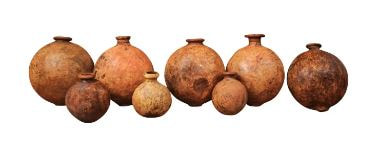
Mexican wine jugs, 1830s
In 1629, a Franciscan monk named Fray Garcîa de Zuñiga and a Capuchin monk named Antonio de Arteaga decided that New Mexico had been deprived of their own wine long enough. They smuggled vines out of Spain and planted New Mexico’s first grapes in a field at the Piro Pueblo, just south of present-day Socorro. The cuttings they brought were from a variety of grape known as the Vitis vinifera, which is called the Mission grape today. It is still grown in New Mexico.
Soon, churches all over the region were planting and cultivating their own vineyards. By 1633, New Mexican viticulture was firmly established. But the relationship between Spanish settlers and Native Southwestern tribes deteriorated. In 1680, the Pueblo Revolt led to the expulsion of the Spanish settlers. During their twelve-year absence, many of their vineyards were destroyed.
Soon, churches all over the region were planting and cultivating their own vineyards. By 1633, New Mexican viticulture was firmly established. But the relationship between Spanish settlers and Native Southwestern tribes deteriorated. In 1680, the Pueblo Revolt led to the expulsion of the Spanish settlers. During their twelve-year absence, many of their vineyards were destroyed.
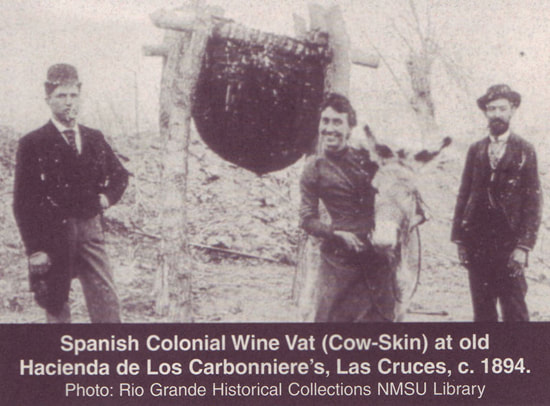
https://aces.nmsu.edu/ces/viticulture/history.html
When the Spanish returned, so did winemaking. Vineyards were planted along the Rio Grande from the northern border with Colorado all the way to the southern border near El Paso, Texas. Spain ceased to dictate policy when it lost control to Mexico. In 1853, New Mexico became a U.S. territory and it opened its borders to the east. The resulting influx of Americans brought significant changes to the land, and to the winemaking industry.
In 1868, Jean Baptiste Lamy, the first bishop of Santa Fe invited Jesuit priests to settle in Albuquerque and establish the Immaculate Conception Parish. Originally from Naples, Italy, the priests brought with them their own winemaking techniques, which they used when they founded their own winery. Other Italians followed, becoming merchants in Albuquerque’s booming downtown. New Mexico’s wine production increased nearly tenfold in the next ten years. By 1880, New Mexico had twice as much acreage in grapevines as New York and ranked fifth in the nation for wine production. By 1900, New Mexico was producing almost a million gallons of wine a year.
In 1868, Jean Baptiste Lamy, the first bishop of Santa Fe invited Jesuit priests to settle in Albuquerque and establish the Immaculate Conception Parish. Originally from Naples, Italy, the priests brought with them their own winemaking techniques, which they used when they founded their own winery. Other Italians followed, becoming merchants in Albuquerque’s booming downtown. New Mexico’s wine production increased nearly tenfold in the next ten years. By 1880, New Mexico had twice as much acreage in grapevines as New York and ranked fifth in the nation for wine production. By 1900, New Mexico was producing almost a million gallons of wine a year.
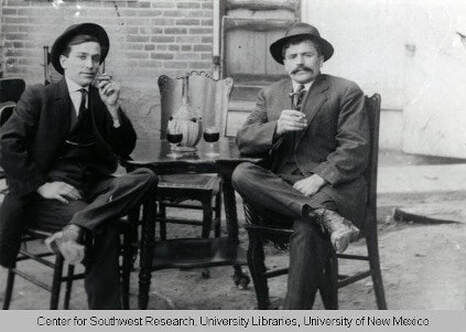 Ovidio and Ettore Franchini, proprietors of Franchini Brothers store, enjoying a glass of homemade Italian wine ca 1910. (Photo courtesy of Henrietta Berger, Center for Southwest Research, University Libraries, University of New Mexico, 2009-03-04
The 20th century didn’t begin well for New Mexico’s vineyards. In the 1920s, Prohibition limited wine production to small amounts for medicinal and sacramental purposes. Then a series of flood, including one in 1943 that was the largest flood in 100 years, destroyed the fields. Many thought that New Mexico would never again become a major producer of wine.
Once again, New Mexico’s wine industry bounced back. Beginning in the 1970s, small commercial wineries began operating in New Mexico. There were four in 1979. Two years later, Hervé Lescombes a winemaker from Burgundy, France came to try his luck in the desert. Many other European investors followed. Today, more than 40 wineries and vineyards produce more than tens of thousands of gallons of wine annually in New Mexico, contributing millions of dollars to the state’s revenue.
Let us raise a glass to the tenacity of those who kept New Mexico’s wineries going, despite laws, rebellions, drought and flood.
Once again, New Mexico’s wine industry bounced back. Beginning in the 1970s, small commercial wineries began operating in New Mexico. There were four in 1979. Two years later, Hervé Lescombes a winemaker from Burgundy, France came to try his luck in the desert. Many other European investors followed. Today, more than 40 wineries and vineyards produce more than tens of thousands of gallons of wine annually in New Mexico, contributing millions of dollars to the state’s revenue.
Let us raise a glass to the tenacity of those who kept New Mexico’s wineries going, despite laws, rebellions, drought and flood.
A former New Mexico history teacher, Jennifer Bohnhoff was born in the southern part of the state and has lived her entire adult life in New Mexico. She has written several historical fiction novels, some of which are set in New Mexico. Visit her blogsite for more information on her and her novels.


No comments:
Post a Comment