Sunday, June 6, 2021


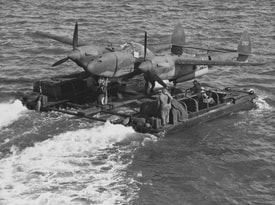
PictureTwo DUKWs carrying a P-38. (Photo: Worldwarphotos.info)
After World War II had ended, General Dwight Eisenhower wrote that while most of his senior officers considered the bulldozer, the Jeep, the 2,5-ton truck, and the C-47 airplane the four most vital pieces of military equipment to the Allies’ success, he thought that the DUKW was “one of the most valuable pieces of equipment produced by the United States during the war.” (Philip Handleman, and Walter J. Boyne, editors: Brassey’s Air Combat Reader, pg. 255). Not everyone shared Ike’s enthusiasm for the amphibious vehicles commonly called ‘ducks.” Their less than stellar performance during the D-Day invasion made many suspicious of them.

DUKW, which comes from the model-naming terminology used by GMC, is an acronym for the fact that it was “D,” designed in 1942, “U,” a utility vehicle that was “K,” all-wheel drive, with “W,” two rear axles. Soldiers, who had nicknames for everything, first called them Ducks. The vehicle was developed in only 38 days through a collaboration between yacht designers Sparkman & Stephens and General Motors. It had a 104 horsepower Chevy engine which was able to reach 50 mph on land and 6 mph on water. They were 31 feet long, 8 feet wide, and 7 feet high. A quarter of the 21,000+ DUKWs that were manufactured between 1942 and 1945 had .50 caliber Browning machine guns ring-mounted to them. 
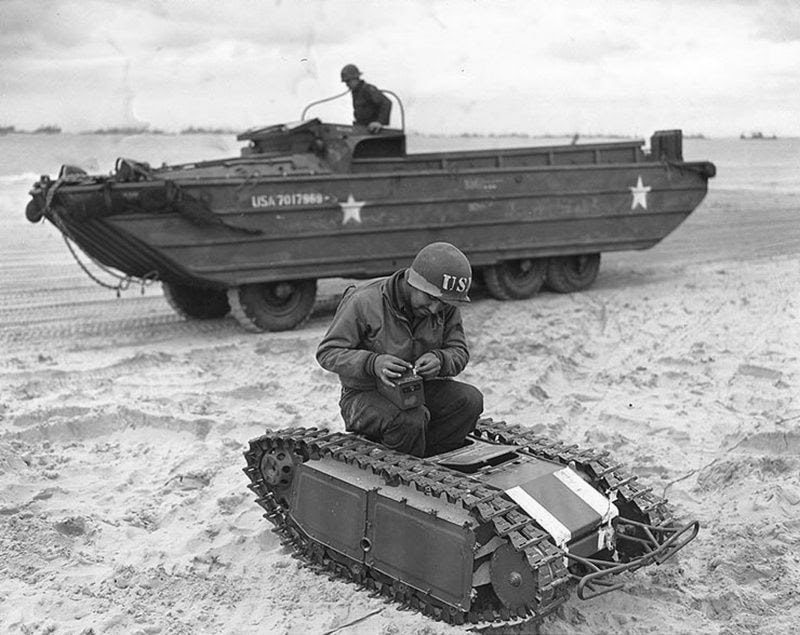
PictureA DUKW at Utah Beach. In front, a soldier inspects a German Goliath tracked mine. (Photo: world-war-2.wikia.org)
DUKWs, which were able to carry a payload of 2.5 tons, or around 20 troops with all their equipment, were originally designed to allow the military to drop cargo off where there were no ports at which to dock supply ships. It was the first vehicle to come equipped with a Speir's Device, a central tire inflation system which allowed drivers to vary the tire pressure to adapt to different surfaces. Fully inflated tires were good for hard surfaces such as roads, while softer tires gave better grip on beach sand.

The Army was not impressed with its design at first, and rejected them. However, when a Coast Guard patrol craft ran aground on a sand bar during a storm near Provincetown, Massachusetts, a prototype DUKW that was being tested nearby was able to save the patrol craft’s crew. The Army, now aware of the craft’s versatility, changed its mind. By March 1943, they were successfully being used in Guadalcanal in the South Pacific. They were also used to great effect in Operation Husky, the 1943 invasion of Sicily. In addition to their normal transport duties, DUKWs were used as naval ambulances and for providing fire support to landing troops. 

Opinions on DUKWs changed after their failure during the D-Day Invasion, where all but one of the vehicles being used to haul howitzers to Omaha Beach sank shortly after debarking from their carriers. This wasn’t a failure of the vehicle so much as a failure of command to understand the DUKW’s limitations. In good weather, DUKWs perform well. In bad weather, especially in high waves and when loaded with heavy cargo such as howitzers, they are not seaworthy. 
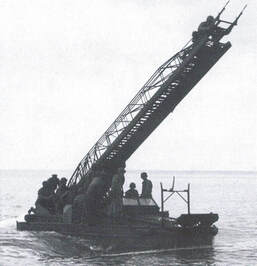
PictureThe specially modified DUKW with an extension ladder used at Pointe du Hoc (Photo: Mikesresearch.com)
Not all DUKWs performed badly, even on the choppy waters of the Norman Coast. U.S. Rangers used specially modified DUKWs with 100foot extension ladders to climb the steep cliffs of Pointe du Hoc to take out the German gun emplacements there.

Most DUKWs were decommissioned after World War II. A few hundred went to the Korean War and to Vietnam, while others were distributed to police and civilian search-and-rescue units, where they continue to serve. 

Picture
Jennifer Bohnhoff's historical novel Code: Elephants on the Moon tells the story of a young French woman who becomes involved in the Resistance movement in preparation for the Allied Invasion on D-Day. You can see pictures of the village where the action takes place here

Sunday, May 30, 2021

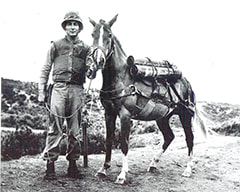
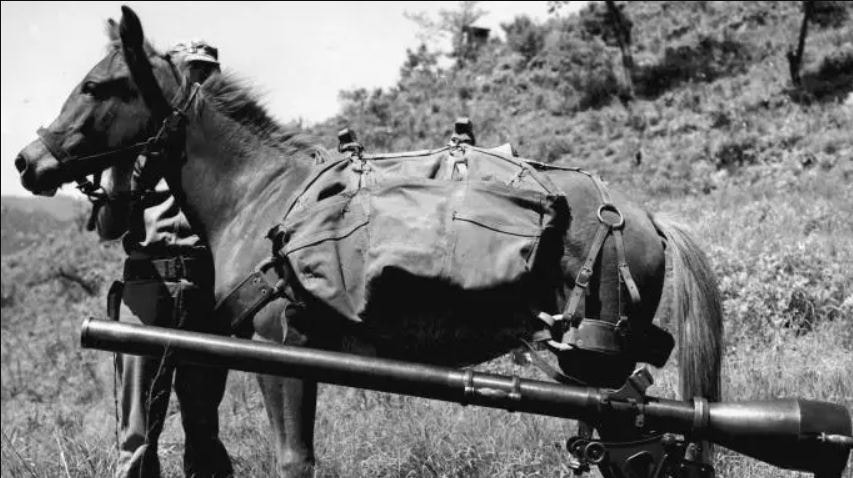
Horses in History: The Four Legged Sergeant


Wednesday, May 5, 2021

American Mothers and Authors


May is the month in which we celebrate Mother's Days, so it seems appropriate to recognize some American mothers who were also authors.
Picture
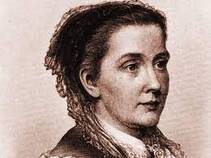
Anne Bradstreet (March 20, 1612 – September 16, 1672) was the wife of the  governor of the Massachusetts Colony and the mother of eight children, but she was also a poet who wrote about marriage, family and the natural world. Her first book of poetry, The Tenth Muse Lately Sprung Up in America, was published in London in 1650, making her the first American woman to be published in Europe and the New World. 

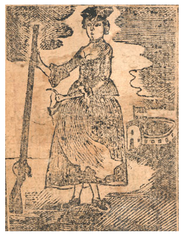
PictureIllustration from a 1770 edition of Rowlandson's book.
Mary Rowlandson (c. 1637 – January 5, 1711) was the wife of a minister and mother of four children, one of whom died in infancy. The family lived in Lancaster, Massachusetts, a town that was on the edge of the wilderness at that time. In 1676, during King Philip's War, Lancaster was raided by Narragansett, Wampanoag, and Nipmuc Indians, and Mary and her her three children were taken. One of her daughters died of wounds after a week of captivity, but Mary and her remaining two children were ransomed after eleven weeks. Six years later, Rowlandson published The Sovereignty and Goodness of God: Being a Narrative of the Captivity and Restoration of Mrs. Mary Rowlandson, which many consider to be America's first best-seller.

Picture
Julia Ward Howe (May 27, 1819 – October 17, 1910) may be best know as the author of the “Battle Hymn of the Republic,” but it is just one of many poems she wrote. In addition, she was the author of plays, and books, and the publisher of literary magazines. She was also the mother of six children, active in advocating for world peace, women’s education, and women's right to vote. Julia wrote extensively over the course of her life and was also active as a speaker who championed morality and Christianity. 

In 1872, Howe asked for June 2 to become a "Mother's Day for Peace." Although she was unsuccessful, Anna Jarvis, the women who managed to establish the modern Mother's Day 36 years later reportedly was inspired by her own mother's work with Howe.

Vanilla Wafers

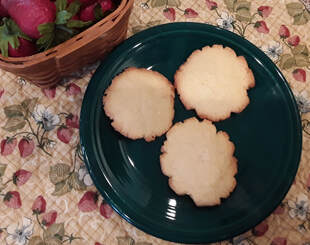
Surely you've bought a box of vanilla wafers before. Why not make them yourself? These not too sweet cookies are perfect for accompanying a bowl of strawberries or a fruit salad, or as the base in banana pudding. If you are having a mother's day celebration, be sure to include them. 
Picture
1/2 cup butter
1.2 cup shortening
2/3 cup sugar
2 tsp. vanilla
1 tsp salt 
2 eggs
2 3/4 cups flour

Cream butter, shortening and sugar together until fluffy. Add vanilla and salt. Add eggs, one at a time, beating well after each. Stir in flour. 

Scoop up dough with a teaspoon, roll into a ball, then set on a parchment-lined cookie sheet, 2" apart. Flatten with the bottom of a glass that has been dipped in flour so it doesn't stick. 

Bake at 375 for 10-12 minutes, until browned on the edges. Let cook on a rack.
 

Picture
Jennifer Bohnhoff is the mother of three fine sons, the mother-in-law of three wonderful daughters in law, and the grandmother of three granddaughters and one grandson. She lives in New Mexico, where she teaches New Mexico History and writes. You can find out more about her at her blog. 

Sunday, April 25, 2021

Welsh Border Castles


Sunday, April 18, 2021

A Tribute to Philip, Warrior Prince


Picture
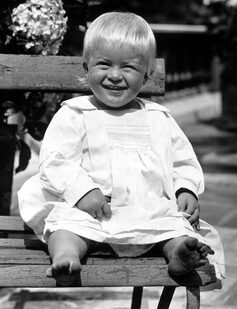
Prince Philip was born into war. When Princess Alice of Battenberg gave birth to him on the Greek island of Corfu on June 10, 1921, the Greco-Turkish War had already been raging for two years. His father, Prince Andrew of Greece, commanded a Greek Army division and his uncle, King Constantine I, was the high commander of the Greek expeditionary force.  The only son and fifth child, Philip’s parents had him baptized into the Greek Orthodox Church. As a member of the House of Schleswig-Holstein-Sonderburg-Glücksburg, he was in line of succession to both the Greek and the Danish thrones.

But the war was going badly, and when Philip was just 18 months old, Greeks revolted against their King. Constantine was forced to abdicate, and Prince Andrew, his wife, four daughters, and infant son were banished. The family escaped on the British naval vessel HMS Calypso, where the infant Philip slept in a cot made from a fruit box. In Paris, an aunt took them in.


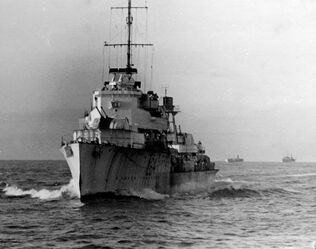
PictureThe HMS Wallace. It had the nickname "One round Wallace", as the very first shot it fired in the war brought down a German airplane
The family spiraled down after that. Philip was shuffled from school to school, beginning in Paris, then moved first to a British school, then a German one. As the Nazi party grew, his school moved to Scotland, and from there he moved to the Royal Naval College in Dartmouth. As he shuffled from school to school, his four sisters married German princes and joined the Nazi party, his mother was committed to an asylum for schizophrenia, and his father moved to Monte Carlo. The young prince was left in the care of his uncle and guardian, Lord Milford Haven. When Haven died of cancer, his brother Louis Mountbatten, took over Philip’s guardianship, and Philip took the name Mountbatten as his own.

While he was at Dartmouth, King George VI and Queen Elizabeth visited, and Philip was asked to escort the King's two daughters, who were his third cousins through Queen Victoria. The king’s older daughter, Elizabeth, who was only 13, began exchanging letter with Philip soon after that.

In 1940, Philip graduated from Dartmouth as the best cadet in his class. He was appointed as a midshipman and served in the Indian Ocean aboard the battleship HMS Ramillies,the HMS Kent, and the HMS Shropshire. After Italy invaded Greece in October, he transferred to the battleship HMS Valiant, which was sailing in the Mediterranean. He fought in the Battle of Crete, and the March, 1941 Battle of Cape Matapan, where the 19-year-old sub-lieutenant was in charge of manning the searchlights used to spot enemy ships. He found two different targets, which his battleship was able to sink, earning himself the Greek War Cross. 

By July 1943, Philip was a first lieutenant serving on the destroyer HMS Wallace. During the Allied Invasion of Sicily, the Wallace was targeted by a Luftwaffe bomber who repeatedly attacked. Philip came up with the idea of assembling a wooden raft, which they loaded with smoke pots and launched. Apparently, the German pilot mistook the smoking, flaming raft for the Wallace, which was able to slip away in the dark of night. 

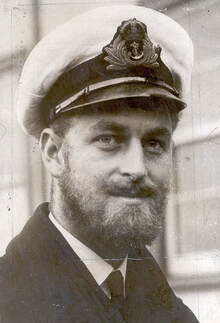
PictureThe 1945 picture of Philip that Elizabeth kept on her dressing table throughout the last year of the war.
In 1944, Prince Philip was transferred to the Pacific, where he served aboard the HMS Whelp. Two rescued British airmen whose bomber was shot down by the Japanese over the ocean discovered who he was only after they saw Princess Elizabeth's photo in his cabin, where he had left them as he collected hot food and dry clothes for them. Elizabeth had a picture of the bearded lieutenant on her dressing table, but no down pilots sat on her bed while awaiting supplies.

After the war ended, Philip asked the King for his daughter's hand in marriage. The King asked that a formal engagement be delayed until Elizabeth's 21st birthday, in April of 1947.

​Philip had to relinquish his Greek and Danish royal titles, but he did not give up his position in the Navy. After his marriage on November 20, 1947, he continued to serve, first at the Admiralty, and then at the Navel Staff College in Greenwich. He eventually was promoted to commander, and commanded the frigate HMS Magpie. In 1952, Elizabeth’s father, King George VI died and Elizabeth ascended the throne. Philip then gave up his military career to support his wife, but he continued to  hold many honorary titles in the Army, the Navy and the Air Force. He also received pilot training with the RAF, and continued flying until the late 1990s. He remained a warrior at heart throughout his life. 


Jennifer Bohnhoff is an educator and writer who lives far from the sea, in the mountains of central New Mexico. When she was a young girl attending Oxford University in the late 1970s, it was rumored that Philip might just become her father in law. You can read more about that here.  For more about her books, visit her blog. 

Monday, April 12, 2021

Fimbulwinter and The Promise of Spring


Picture
Spring is so full of promise. The emergence of the first, green shoots and the twitter of nesting birds inspires hope in our hearts. But what if, one spring, that didn't happen? How would it affect us? 

Picture
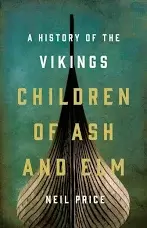
In Children of Ash and Elm, Neil Price suggests that the Viking's concept of Ragnarok, the cataclysmic final battle at the end of the world, might have been formed when volcanic eruptions threw so much ash into the atmosphere that spring seemed not to come. In 536, 539, and 547, major volcanic eruptions, probably in El Salvador at what is now Lake Ilopango, caused world wide ecological consequences that are documented in written sources as far divergent as China, India, the Mediterranean, and the Goths of central Europe.

Fimbulwinter, or Mighty Winter of Scandinavian lore may have been inspired by this. Snorri, in his Edda, says that when Fimbulwinter comes, "there will be great frosts and keen winds. The sun will do no good. There will be three of these winters together, and no summer between."

​Dendrochronological records from this period show that trees withered, their growth rings stunted. The failed harvests created riots and famine. In Scandinavia, tens of thousands starved to death, and the population suffered losses of an estimated 50%. Price says that this devastation led to a dissolution of  the sociopolitical structures in Scandinavia, and the beginning of what is called the Viking age. What they feared to be the end of civilization proved to be the beginning of a new era.

The Vikings were in no way responsible for the destruction of the ecology in the 6th century. Those volcanic eruptions were a natural occurrence. And while natural disasters continue to happen, it seems that many others are not natural at all, but human made. 

Picture
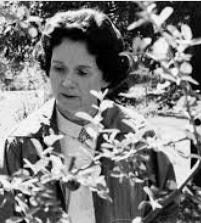
In her 1962 book Silent Spring, biologist Rachel Carson warned that the heightened use of DDT and other pesticides after World War II was going to lead to a human-created Fimbulwinter.  In our attempt to choose what species were to live and what were to die because we had deemed them pests, humans were going to destroy the food chain, leading to the death of far more species than we intended. As birds' shells became thinner, their chicks would die. The springtime sound of birds would be no more. Fortunately for us, politicians listened and the crisis was averted. Out of her warnings, a new ecological consciousness developed and a new era of environmentalism was born. 

The jury is still out on whether COVID-19 was a man made or natural disaster. We still don't know whether this virus developed on its own or in a lab. But for many, the year-long quarantine has felt like fimbulwinter. Once again, society has had to react to imminent disaster. It will be interesting to see how this, too, will lead to a new era. 

Bird Nest Cookies

Celebrate the promise of spring with these not too sweet cookies. 
Picture
1/2 cup brown sugar
1 cup softened butter
2 eggs, separated (you will need 2 yolks and 1 egg white for this recipe)
1 tsp vanilla
2 1/4 cup flour
1/2 tsp salt
1/2 cup unsweetened shredded coconut
1/3 cup finely chopped pecans
candy coated chocolate eggs or small jelly beans

Heat oven to 350. Line cookie sheets with parchment. 

In large bowl, beat brown sugar and butter until light and fluffy.
Add egg yoks and vanilla and blend well. 
Add flour and salt and blend well. 

Shape dough into 1 inch balls.

In small bowl, slightly beat 1 egg white (use the other egg white for another purpose)

In another small bowl, mix coconut and pecans. 

Dip the tops of cookie dough balls into the egg white, then into the coconut and nut mixture. Set on the parchment-lined cookie sheet, coconut side up, 1" apart. 
Use your thumb to make an indentation in the center of each cookie. 

Bake at 350 for 8-10 minutes, or until lightly browned. As soon as they are out of the oven press a chocolate egg or jelly bean into the dent in the dent in the middle of each cookie before moving to a cooling rack. 

Sunday, March 21, 2021

Buffalo Soldiers


Picture
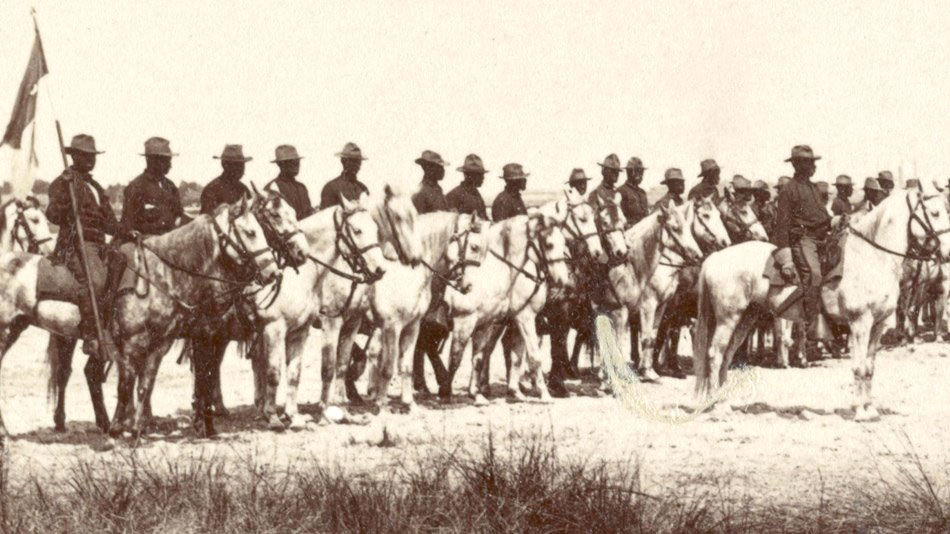
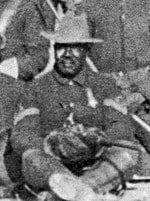
In 1866, right after the close of the Civil War, Congress created six (later consolidated to four) regiments of African-American soldiers. These units, the 9th and 10th Cavalry, and the 24th and 25th Infantry, quickly became known as “The Buffalo Soldiers.”

Picture
There are at least three different stories concerning how these units came by their nickname.

The most plausible in my mind is that the Plains Indians, who fought the Buffalo Soldiers, thought that their dark skin and black curly hair looked much like the coloring and fur of the buffalo.

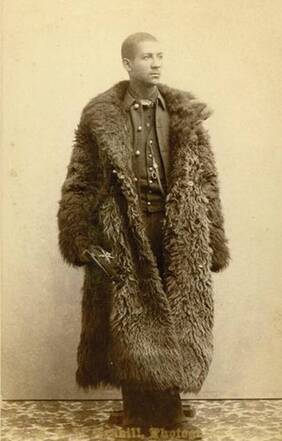
A second theory is that they were named after the thick buffalo-hide coats the troops wore during the winter.

​A third theory is that they were awarded the name because of the ferocity and bravery of their actions. 

Picture
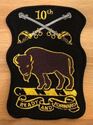
Regardless of how the name came to be, the soldiers themselves were proud of it and considered it high praise since buffalo were deeply respected by the Native peoples of the Great Plains. Eventually, the buffalo became the image on the 10th Cavalry's regimental crest.

At first, regiments of Buffalo Soldiers faced a lot of racial prejudice. Because many whites didn't want to see armed black soldiers in or near their communities, the Buffalo Soldiers were assigned to forts west of the Mississippi River, where they supported the nation's westward expansion by protecting settlers, building roads and other infrastructure, and guarding the U.S. mail. They were also involved in many of the military campaigns of the Indian Wars. They served with distinction, earning an impressive 18 Medals of Honor during this period.
Picture
​ Since there were no African American officers, the units were commanded by whites. Some officers, like George Armstrong Custer, were so opposed to allowing blacks into the Army that they refused to command black regiments even when it cost them promotions. Others, like John Pershing, accepted the command but were branded for it. Pershing got the nickname “Black Jack” for his time commanding the 10th Cavalry. At first, it was given to him derisively, but he managed to turn it into a badge of honor.

George Jordan, of  K Troop, 9th Cavalry Regiment, earned his prestigious medal for repulsing a force of more than 100 Indians while he and his detachment of 25 men were stationed at Fort Tularosa, N. M., and then for holding his ground in an exposed position so that a larger force of Indians could not surround his command in Carrizo Canyon.

Picture
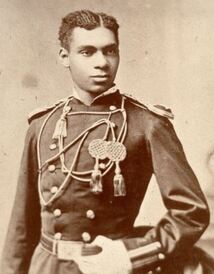
Eventually, the exceptional performance of the Buffalo soldiers led to their advancement into positions of authority. The first black officer to command soldiers in the regular U.S. Army, Henry O. Flipper, was born a slave in Georgia but graduated from West Point Military Academy in 1877, commissioned as a second lieutenant, and was assigned to the 10th Cavalry Regiment. He faced intense resentment from some white officers and became the target of a smear campaign that culminated in a court martial and his dismissal from the Army in 1882. He was posthumously pardoned by President Clinton in 1999.

Buffalo Soldiers continued to serve their country, both in the west and abroad. They helped in the 1892 Johnson County War in Wyoming, which pitted small farmers against wealthy ranchers and a band of hired gunmen. They also fought in the Spanish-American and Philippine-American Wars, and served along the U.S.-Mexico border and in the Expedition to find Pancho Villa.  However, they continued to suffer racism.  Woodrow Wilson excluded black regiments from the American Expeditionary Force and placed them under French command. During World War II, most of the 9th and 10th Cavalry Regiments were moved into service roles. The two exceptions were the 92nd Infantry Division, which saw combat during the invasion of Italy, and the 25th Infantry Regiment, which fought in the Pacific. During the Korean War, the last of the segregated U.S. Army regiments were disbanded and their troops integrated into other units.

History Lessons from a Walk in the Maine Woods

  I recently got back from a wonderful month in Maine. My husband and I rented a house right on a lake, and we spent a good portion of our t...