
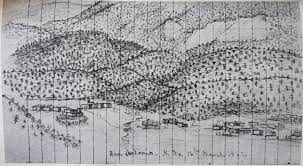
 A sketch of San Antonio, New Mexico, by A. Petticolas, Confederate soldier
A while back, a neighbor was over and we were talking about the history here on the east side of the Sandia Mountains. He was raised here. I spent my teens in Albuquerque, the city that lies just west of the Sandias. I hiked in the mountains plenty, and I had friends that lived over here, especially after I got to high school. Manzano High School was, and still is the high school that kids from the east mountains attended. I’ve always been interested in the geology of the mountains. Its most ancient of records are the rocks, which tell us that what is now the top of a mountain used to be at the bottom of a sea. But I didn’t become interested in the human history of the east mountains, its small towns, and the people who inhabited them until I moved here in 2017.
This visiting neighbor told me he’d like to get his hands on a novel entitled Fiddlers and Fishermen because it was set in the east mountains. He’d searched, but he’d never been able to find a copy. That set me on a mission that began on Google, went to the public library, and finally to rare booksellers. What I discovered was that Fiddlers and Fishermen is one of two books written by Benjamin Frederick Clark. Born in Kansas in 1873, Clark moved into a cabin in Sandia Park, New Mexico in 1927. He passed away in that same cabin on May 30, 1947. He was 74 years old.
This visiting neighbor told me he’d like to get his hands on a novel entitled Fiddlers and Fishermen because it was set in the east mountains. He’d searched, but he’d never been able to find a copy. That set me on a mission that began on Google, went to the public library, and finally to rare booksellers. What I discovered was that Fiddlers and Fishermen is one of two books written by Benjamin Frederick Clark. Born in Kansas in 1873, Clark moved into a cabin in Sandia Park, New Mexico in 1927. He passed away in that same cabin on May 30, 1947. He was 74 years old.
Back in 1947, Sandia Park was the area uphill from the little village of San Antonito. A dirt road went through the middle of it on its way up to the crest of the mountain. My area was on the outskirts of a village called La Madera, whose economy was based on truck farming, limestone mining, and timber. The stream that was the lifeblood of La Madera has ceased to flow and the town has become a ghost town. I drive a little over six miles to get my mail at the Sandia Park Post office.
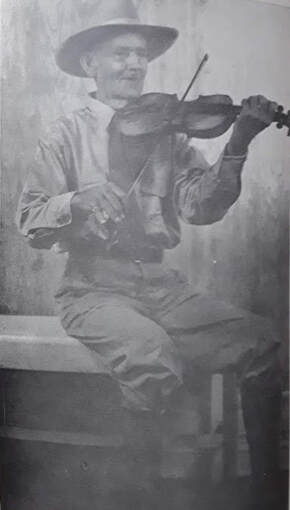
Clark’s other book is a small tome of poems. Entitled Melodious Poems from the Hills, it was published in 1945 under the pen name of Sandia Bill by Crown Publications. I managed to get a copy delivered to my local library through interlibrary loan. The copy is signed, in pencil, by the author. A second pencil notation, reading “gift of the author 6/30/45” is written along the gutter of the first page. There is a picture of Clark playing his fiddle in the frontpages. I have included it here.
Melodious Poems from the Hills has ninety-six pages. Some pages have two short poems on them. Most have one poem, and a few poems span a couple of pages. The first poem, “When I Am Dead,” is mentioned in his obituary and is the reason he was cremated.
Clark’s other book is a small tome of poems. Entitled Melodious Poems from the Hills, it was published in 1945 under the pen name of Sandia Bill by Crown Publications. I managed to get a copy delivered to my local library through interlibrary loan. The copy is signed, in pencil, by the author. A second pencil notation, reading “gift of the author 6/30/45” is written along the gutter of the first page. There is a picture of Clark playing his fiddle in the frontpages. I have included it here.
Melodious Poems from the Hills has ninety-six pages. Some pages have two short poems on them. Most have one poem, and a few poems span a couple of pages. The first poem, “When I Am Dead,” is mentioned in his obituary and is the reason he was cremated.
When I Am Dead
When I am dead, don’t cry for me;
Just wrap me in a shroud
And burn me, that the vapors may
Help form some lovely cloud.
Then place my pictures and my dolls,
And my ashes pure and clean,
‘Neath my rosevine and that tree
That always is so green.
Just leave the earth plain and smooth--
I want no omark or stone.
Just let the yard look like it did;
When in flesh, it was my home.
Take care of my sweet rosevine
And that evergreen tree –
This still my home will be;
And may flowers bloom around by tome
While gay robins sing for me.
This was one of my favorites, and seems appropriate in a year that saw so much of the west burning:
Just wrap me in a shroud
And burn me, that the vapors may
Help form some lovely cloud.
Then place my pictures and my dolls,
And my ashes pure and clean,
‘Neath my rosevine and that tree
That always is so green.
Just leave the earth plain and smooth--
I want no omark or stone.
Just let the yard look like it did;
When in flesh, it was my home.
Take care of my sweet rosevine
And that evergreen tree –
This still my home will be;
And may flowers bloom around by tome
While gay robins sing for me.
This was one of my favorites, and seems appropriate in a year that saw so much of the west burning:
The Dying Monarch
Here stands the monarch of the forest,
Slowly expiring on the mountainside,
Who only a few hours ago,
Was the embodiment of health and pride.
His kindred pines for miles around,
And neighboring aspens, oaks, and firs
Are slowly tumbling to the ground
In bulks of smoldering embers.
The Lively squirrels and cheerful birds
From these parts have fled,
And they’ll be homeless for awhile,
For their friendly trees are dead.
Stands here the monarch of the forest,
Preaching a sermon as he expires,
Broadcasting his message to the world:
“Oh, men, be careful with your fires.”
Like the poem above, many of Sandia Bill’s poems are about the nature that surrounded him. Some are about the people, mostly ranchers, who he associated with. A few tell tales of love lost and found, of pretty women, dangerous men, and faithful old dogs, horses, and mules. This one, dear reader, I find speaks his heart, and mine.
Slowly expiring on the mountainside,
Who only a few hours ago,
Was the embodiment of health and pride.
His kindred pines for miles around,
And neighboring aspens, oaks, and firs
Are slowly tumbling to the ground
In bulks of smoldering embers.
The Lively squirrels and cheerful birds
From these parts have fled,
And they’ll be homeless for awhile,
For their friendly trees are dead.
Stands here the monarch of the forest,
Preaching a sermon as he expires,
Broadcasting his message to the world:
“Oh, men, be careful with your fires.”
Like the poem above, many of Sandia Bill’s poems are about the nature that surrounded him. Some are about the people, mostly ranchers, who he associated with. A few tell tales of love lost and found, of pretty women, dangerous men, and faithful old dogs, horses, and mules. This one, dear reader, I find speaks his heart, and mine.
I Am Thankful
I am not a rich or famous man,
And perhaps I’ll never be.
But I am in love with many things
And they’re all in love with me.
I am thankful for the sweet sunshine,
For snow, the clouds, and summer showers.
I am thankful for the Love Divine,
For butterflies, the birds, and flowers.
I am thankful for the girl I love
With eyes so soft and blue;
I am thankful for the stars above,
But more thankful, dear, for you.
I have yet to get my hands on a copy of Fiddlers and Fishermen. The only copy I’ve managed to locate is housed in the special collections in Zimmerman Library on the University of New Mexico campus, and they are not willing to circulate it through interlibrary loan. The only way I can read this 76 page novella is to make an appointment to read it at the library. Zimmerman’s old reading room is a beautiful, contemplative space. I did much of my undergraduate study there because it was such a peaceful place. Perhaps someday soon I will jump through the hoops to make this appointment happen.
And perhaps I’ll never be.
But I am in love with many things
And they’re all in love with me.
I am thankful for the sweet sunshine,
For snow, the clouds, and summer showers.
I am thankful for the Love Divine,
For butterflies, the birds, and flowers.
I am thankful for the girl I love
With eyes so soft and blue;
I am thankful for the stars above,
But more thankful, dear, for you.
I have yet to get my hands on a copy of Fiddlers and Fishermen. The only copy I’ve managed to locate is housed in the special collections in Zimmerman Library on the University of New Mexico campus, and they are not willing to circulate it through interlibrary loan. The only way I can read this 76 page novella is to make an appointment to read it at the library. Zimmerman’s old reading room is a beautiful, contemplative space. I did much of my undergraduate study there because it was such a peaceful place. Perhaps someday soon I will jump through the hoops to make this appointment happen.
Jennifer Bohnhoff’s newest novel, Where Duty Calls, is set in New Mexico during the Civil War and is the first in a trilogy. Written for middle grade readers, it is a quick, informative read for adults. She lives and writes in the mountains east of Albuquerque, New Mexico, close to the camp the Confederate Army used as they advanced towards Santa Fe in the spring of 1862 that is pictured above. .


No comments:
Post a Comment