Friday, September 23, 2022

Stories about Living During the Vietnam War Era for Middle Grade Readers


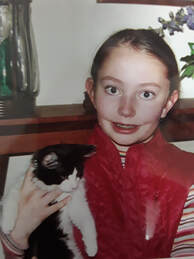
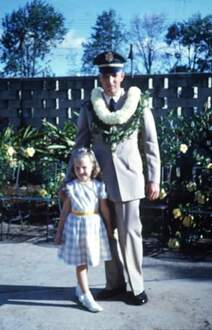
PictureThe author and her Uncle, probably in 1965. I don't believe he served in Vietnam, but I don't really remember.
It’s stunning to me that the Vietnam War is ancient history for today’s middle schoolers. To old folks like me, who grew up while our soldiers were wading through rice paddies and jungles, it seems unbelievable that today’s kids wouldn’t know anything about the Vietnam War, or what it was like here on the home front during that tumultuous period. But then I got to analyzing how much time has passed, using real numbers (something I don’t often do!) and I realized that it’s perfectly understandable that today’s middle grade readers know so little.

I am just slightly too young to have much personal experience with the Vietnam War. The war ended when Saigon fell on the 30th of April 1975. I was in high school by then, but the war was old news that few people cared about. For many Americans, the war was over in December of 1972, when the last draft call was held, or in March of 1973, when the last of our ground troops left Vietnam.  I was still in Junior High then. I had some friends whose older brothers were in the draft, and a few who went over and served, but most of the people I knew where involved in the war were a generation removed from me, and were fathers of friends, old enough to have command or desk jobs. My husband registered for the draft, but the draft had ceased before he could be called up. 
Picture
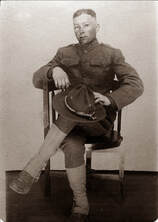
My grandfather served during World War I, which ended 41 years before I was born. I remember thinking that he was a very old man, and that the war he had served in much have been long, long ago. I assume that an average twelve-year-old, who would have been born thirty-five years after the end of the Vietnam feels the same. If they know anyone involved in Vietnam, it would be a grandparent or even a great grandparent. Ancient history. 
Picture
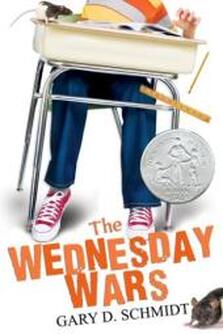
Maybe one of the reasons I loved Gary D. Schmidt’s The Wednesday Wars, a middle grade historical novel that won a Newberry Honor in 2008 is that Schmidt is two years older than I am, so his memories of the period would be much like my own. Reading this novel is much like a trip into my own reminiscences of the period. I remember arguments similar to the one between the protagonist’s conservative father and would-be flower child sister. I remember VW bugs with flower decals, and the horrific shock of the deaths of Martin Luther King and Robert F. Kennedy. The world felt like it was unraveling, and Walter Cronkite was there every evening to explain it all to us.

But The Wednesday Wars isn’t just a book about a particular point in time; it’s also a book about a boy at a particular point in his own development into manhood. Holling Hoodhood may be a seventh grader during the 1967–1968 school year, but many of the problems he faces are similar to those that seventh grade boys still encounter.

Holling’s father is a self-centered architect who is so busy becoming the Chamber of Commerce Businessman of the year that he can’t attend his son’s performance in The Tempest. The father sees every relationship as a potential business association and demands that he, his family, and their house all be above reproach and perfect at all times. It’s a tough standard to attain, particularly for a middle school boy who, as most boys his age, feels gawky and unsure of himself.

Holling finds an unlikely ally in Mrs. Baker, his no-nonsense teacher. On Wednesday afternoons, half of Holling's classmates leave school early for catechism class and the other half attends Hebrew school leaving Holling, the only Presbyterian, alone in the classroom. Holling thinks Mrs. Baker hates him because of this, but after an unexpected disaster involving cream puffs and chalk board erasers, Mrs. Baker introduces Holling to Shakespeare. The Bard becomes the lens through which Holling processes the world around him, including his relationship with his father, with Meryl Lee Kowalski, the daughter of a rival architect, his sister Heather, and even Mickey Mantle. I couldn’t help but love the awkward, fumbling Holling.

Picture
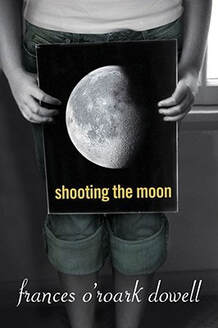
If you’d like to read a story set in the Vietnam War era that has a female protagonist, consider Shooting the Moon, by Frances O'Roark Dowell. Twelve-year-old Jamie Dexter is a military brat whose father is a colonel stationed in Texas. Jamie is proud and excited when her older brother enlists in the Army and is sent to Vietnam. She can't wait to get letters from the front lines describing the excitement of real-life combat, the sound of helicopters, the smell of gunpowder, the exhilaration of being right in the thick of it. But her brother doesn’t send letters. Instead, he sends roll after roll of undeveloped film that shows photos of the moon and gritty pictures that depict a side to war that she has never considered. While Jamie works in the base’s rec office, she begins to question everything she’s ever believed, and when her brother goes MIA and her father can do nothing, Jamie’s innocence is lost and she must grow up quickly. 

Other books about the Vietnam War

Summer's End, by Audrey Couloumbis, is another book featuring a girl growing up during the Vietnam War. When her older brother is drafted but burns his draft card, thirteen-year-old Grace finds herself in the middle of a war raging within her own family.

Ellen Emerson White’s contribution to the Dear America series is Where Have All the Flowers Gone?: The Diary of Molly MacKenzie Flaherty, Boston, Massachusetts, 1968. The book is set up to be the diary entries of a brother who is a Marine stationed in Vietnam, and his sister, a peace activist back in the states.

Georgie's Moon, by Chris Woodworth tells the story of Georgie Collins, whose father gave her standing orders never to let anyone mess with her before he left for Vietnam.  Despite "peacenik" classmates who think the war is wrong and being forced to visit old people in a nursing home, Georgie tries to survive seventh grade in Glendale, Indiana as she waits for her father’s return.

Elizabeth Partridge’s Dogtag Summer tells the story of twelve-year-old Tracy, who was once named Tuyet. Half Vietnamese and half American GI, Tracy has never felt she fit in with her adoptive California family. Finding a soldier's dog tag hidden among her father's things begins a set of events that promise to change everything. 

Times change. Events happen, impress themselves on us, and then we move on. The Vietnam War no longer lives large in the American psyche. It has been replaced by 9/11, COVID, and a dozen other events. But being in the 7th grade and finding oneself on the teetering brink of adulthood remains an important time for individuals.  I think it's important for today's middle grade readers to know that their parents, and their grandparents, and all the generations who came before that also struggled with what it meant to become oneself.

Jennifer Bohnhoff is a former high school and middle school English and history teacher who is now old enough to get to stay home and write. She lives in the mountains east of Albuquerque, New Mexico with her very patient and equally old husband, and a big, rambunctious black dog named Panzer. You can read more about her and her books on her blog. 

Wednesday, August 31, 2022

Giving Back New Mexico


Picture
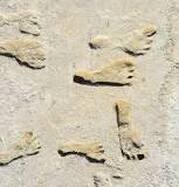
New Mexico has been peopled for tens of thousands of years. The radiocarbon dating of footprints found at White Sands has pushed back human occupation to somewhere between 23,000 and 21,000 years ago. As far as we know, for much of that time, the different people occupied different areas without any formal boundaries.Spheres of influence overlapped. People shared the same hunting grounds and wintering areas, sometimes peacefully and sometimes not. 

Picture
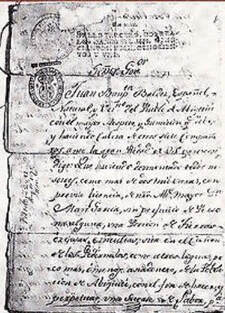
That all changed with the coming of the Spanish in the sixteenth century. The first peoples with a written system to document their intentions, they declared the land the property of the Spanish King and divided it into grants. From early on, the Spanish recognized three different types of land grants. Private grants were awarded to soldiers, nobility, and important people. Community grants were given to groups of people, particularly genizaro. The settled Indian populations, which means the Puebloans, received grants that protected their pueblos and fields from Spanish incursion to some degree.  Those tribes that did not live a settled lifestyle did not receive land grants.

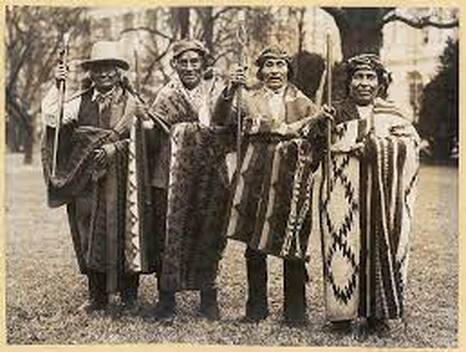
Following the Mexican-American War, the United States took control of the territory. The treaty ending the war recognized the Pueblo land grants. In 1863, President Lincoln presented 19 Pueblo Governors with canes to show that the Federal government recognized their authority. Today there are still 19 Pueblo tribes in New Mexico. Each pueblo is a sovereign nation. 
Picture
1923 photograph of Pueblo leaders in Washington, D.C. to protest the Bursum Bill, which threatened the Pueblos with land loss. They are each holding their Lincoln cane.
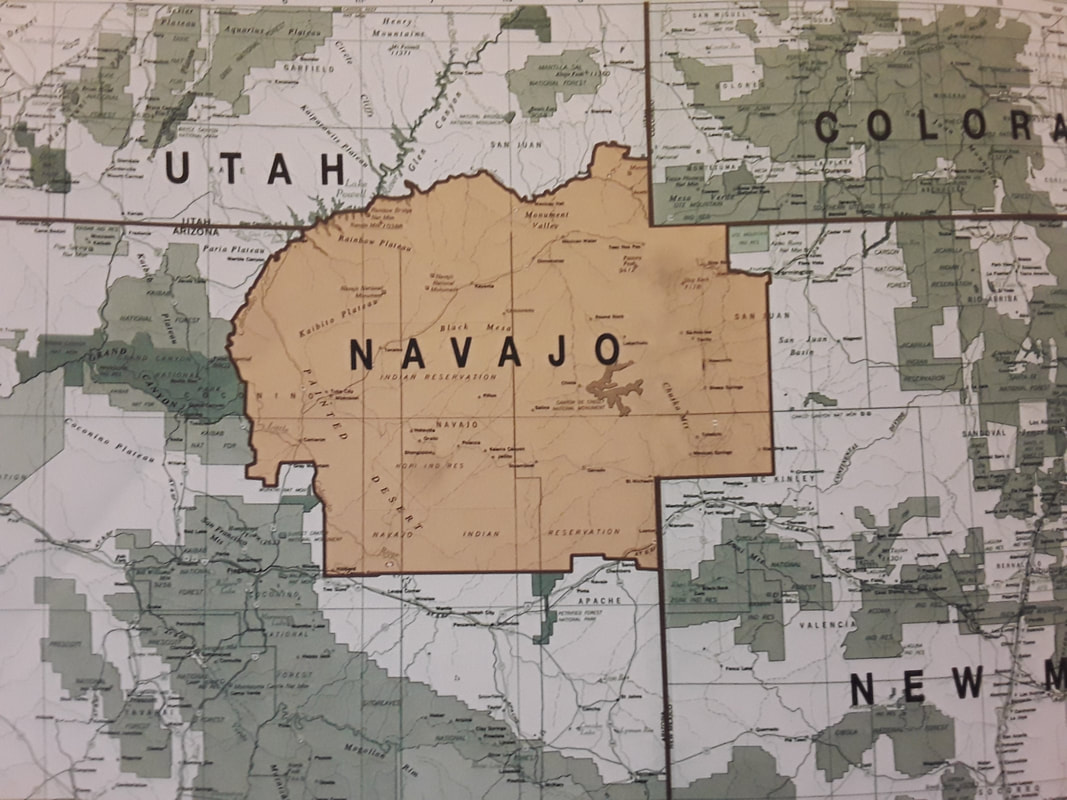
Not all Indigenous peoples in New Mexico lived settled lives. The nomadic tribes: the Apache, Navajo and Comanche tended to live within a range of land, but they did not stay in one place. The Navajo had fields and orchards, but they did not tend them year round. These groups were not given land grants by either the Spanish or the Mexican governments when they controlled New Mexico. 
Picture
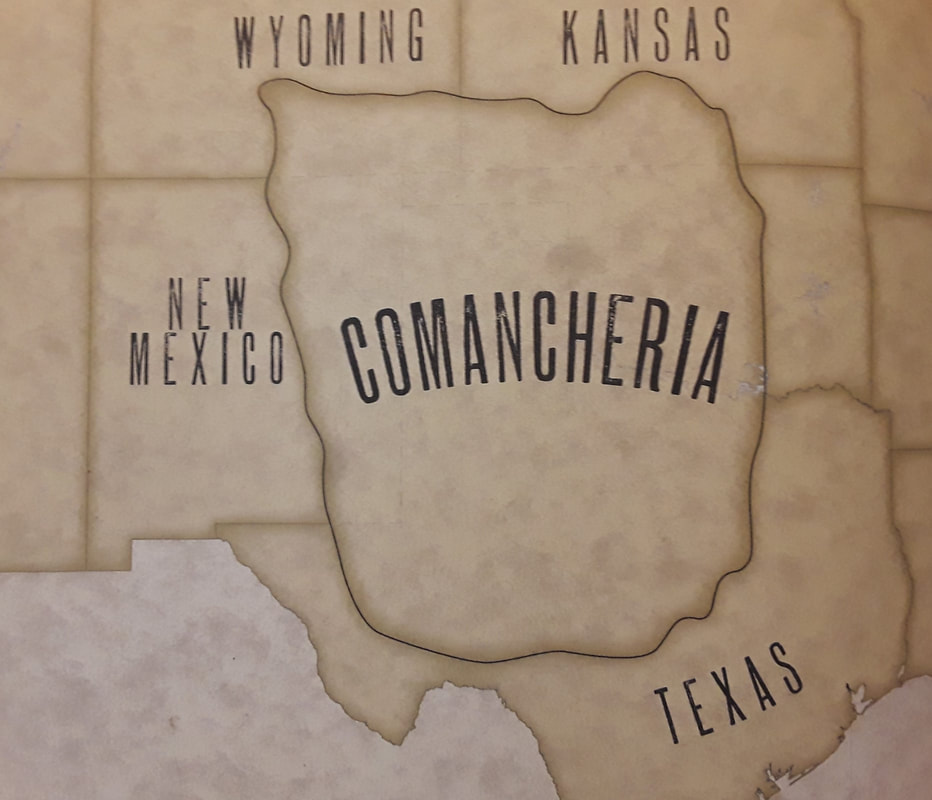
Comancheria, as envisioned by Michael Trinklein in Lost States: True Stories of Texlahoma, Transylvania, and other States that Never Made it.
In 1837, Sam Houston, the President of the Republic of Texas, proposed that the Comanches be given their own land. Their summer range encompassed much of western Texas, large portions of what is now Oklahoma and New Mexico, and  the edges of Colorado and Kansas. The Comanches were fierce fighters. Giving them their own territory would, the Texans hoped, stop them from killing settlers and attacking wagon trains. The Texas congress did not ratify Houston's proposal, and the Comanche's were eventually given a reservation in Oklahoma. Apache tribes have little reservations scattered over several western states, and the Navajo reservation straddles the states of Utah, Arizona and New Mexico. 
Picture
In the 1970s, Navajo tribal chairman Peter McDonald suggested that the Navajo homeland become the fifty-first state, giving its occupants more autonomy and control. The biggest issue at the time was the refusal of Utah to allow the Ft. Hall Navajos to build a casino on their land. While his proposal received national attention in 1974, New Mexico, Arizona and Utah all refused to support it. If the population within the reservation grows, this proposal might be renewed. 

Picture
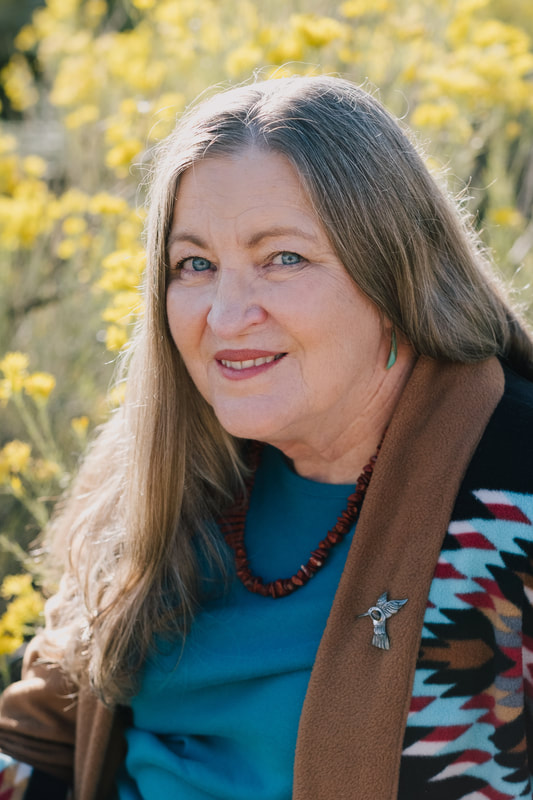
Jennifer Bohnhoff is a retired New Mexico History teacher who now writes historical fiction. She has written about the state during the Civil War in Where Duty Calls, during World War I in A Blaze of Poppies, and is currently at work on a novel set 12,000 years ago during the Folsom period. 

Monday, August 15, 2022

The Bard of the East Mountains


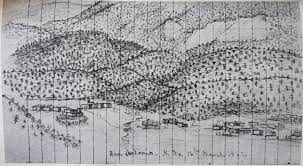
PictureA sketch of San Antonio, New Mexico, by A. Petticolas, Confederate soldier
A while back, a neighbor was over and we were talking about the history here on the east side of the Sandia Mountains. He was raised here. I spent my teens in Albuquerque, the city that lies just west of the Sandias. I hiked in the mountains plenty, and I had friends that lived over here, especially after I got to high school. Manzano High School was, and still is the high school that kids from the east mountains attended. I’ve always been interested in the geology of the mountains. Its most ancient of records are the rocks, which tell us that what is now the top of a mountain used to be at the bottom of a sea. But I didn’t become interested in the human history of the east mountains, its small towns, and the people who inhabited them until I moved here in 2017.

This visiting neighbor told me he’d like to get his hands on a novel entitled Fiddlers and Fishermen because it was set in the east mountains. He’d searched, but he’d never been able to find a copy. That set me on a mission that began on Google, went to the public library, and finally to rare booksellers. What I discovered was that Fiddlers and Fishermen is one of two books written by Benjamin Frederick Clark. Born in Kansas in 1873, Clark moved into a cabin in Sandia Park, New Mexico in 1927. He passed away in that same cabin on May 30, 1947. He was 74 years old. 


Picture
Back in 1947, Sandia Park was the area uphill from the little village of San Antonito. A dirt road went through the middle of it on its way up to the crest of the mountain. My area was on the outskirts of a village called La Madera, whose economy was based on truck farming, limestone mining, and timber. The stream that was the lifeblood of La Madera has ceased to flow and the town has become a ghost town. I drive a little over six miles to get my mail at the Sandia Park Post office.

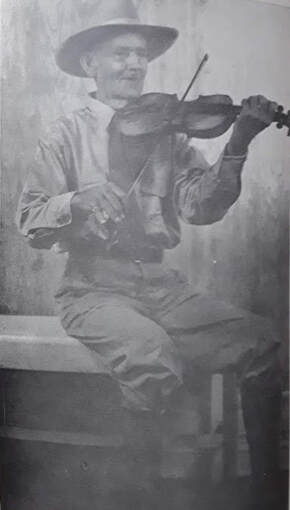
Clark’s other book is a small tome of poems. Entitled Melodious Poems from the Hills, it was published in 1945 under the pen name of Sandia Bill by Crown Publications.  I managed to get a copy delivered to my local library through interlibrary loan. The copy is signed, in pencil, by the author. A second pencil notation, reading “gift of the author 6/30/45” is written along the gutter of the first page. There is a picture of Clark playing his fiddle in the frontpages.  I have included it here.

Melodious Poems from the Hills has ninety-six pages. Some pages have two short poems on them. Most have one poem, and a few poems span a couple of pages. The first poem, “When I Am Dead,” is mentioned in his obituary and is the reason he was cremated.

​When I Am Dead

When I am dead, don’t cry for me;
Just wrap me in a shroud
And burn me, that the vapors may
Help form some lovely cloud.
Then place my pictures and my dolls,
And my ashes pure and clean,
‘Neath my rosevine and that tree
That always is so green.
Just leave the earth plain and smooth--
I want no omark or stone.
Just let the yard look like it did;
When in flesh, it was my home.
Take care of my sweet rosevine
And that evergreen tree –
This still my home will be;
And may flowers bloom around by tome
While gay robins sing for me.

This was one of my favorites, and seems appropriate in a year that saw so much of the west burning: 

​The Dying Monarch

Here stands the monarch of the forest,
Slowly expiring on the mountainside,
Who only a few hours ago,
Was the embodiment of health and pride.
His kindred pines for miles around,
And neighboring aspens, oaks, and firs
Are slowly tumbling to the ground
In bulks of smoldering embers.
 
The Lively squirrels and cheerful birds
From these parts have fled,
And they’ll be homeless for awhile,
For their friendly trees are dead.
 
Stands here the monarch of the forest,
Preaching a sermon as he expires,
Broadcasting his message to the world:
“Oh, men, be careful with your fires.”

Like the poem above, many of Sandia Bill’s poems are about the nature that surrounded him. Some are about the people, mostly ranchers, who he associated with. A few tell tales of love lost and found, of pretty women, dangerous men, and faithful old dogs, horses, and mules. This one, dear reader, I find speaks his heart, and mine. 

​I Am Thankful

I am not a rich or famous man,
And perhaps I’ll never be.
But I am in love with many things
And they’re all in love with me.
 
I am thankful for the sweet sunshine,
For snow, the clouds, and summer showers.
I am thankful for the Love Divine,
For butterflies, the birds, and flowers.
I am thankful for the girl I love
With eyes so soft and blue;
I am thankful for the stars above,
But more thankful, dear, for you.

I have yet to get my hands on a copy of Fiddlers and Fishermen. The only copy I’ve managed to locate is housed in the special collections in Zimmerman Library on the University of New Mexico campus, and they are not willing to circulate it through interlibrary loan. The only way I can read this 76 page novella is to make an appointment to read it at the library. Zimmerman’s old reading room is a beautiful, contemplative space. I did much of my undergraduate study there because it was such a peaceful place.  Perhaps someday soon I will jump through the hoops to make this appointment happen. 


Jennifer Bohnhoff’s newest novel, Where Duty Calls, is set in New Mexico during the Civil War and is the first in a trilogy.  Written for middle grade readers, it is a quick, informative read for adults. She lives and writes in the mountains east of Albuquerque, New Mexico, close to the camp the Confederate Army used as they advanced towards Santa Fe in the spring of 1862 that is pictured above. .

Wednesday, July 27, 2022

Civil War Mules in Fact, Fiction, and Poetry


Picture
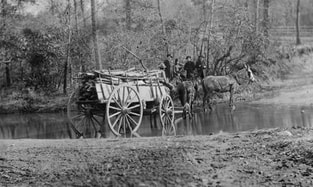
Mules were the backbone of both Confederate and Union Armies during the American Civil War. According to a page on the Stones River Battlefield site, about three million horses and mules served in the warThey pulled the supply wagons, pulled the limbers and caissons for cannons, and moved the ambulances. 

Although mules died in battle, just like the soldiers they supported, a greater percentage died of overwork, disease, or starvation. Rarely was the daily feed ration for Union cavalry horses, ten pounds of hay and fourteen pounds of grain, available during the long campaigns. 

Picture
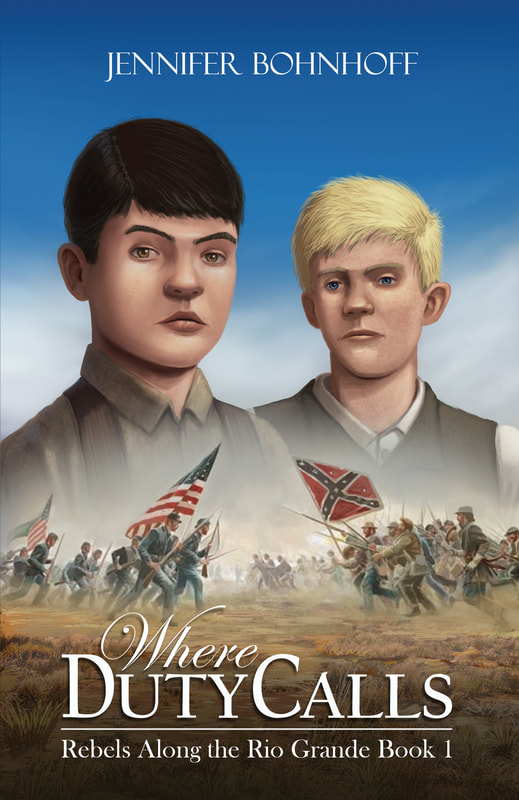
Jemmy Martin, one of the lead characters in Where Duty Calls, my middle grade novel about the Civil War in New Mexico, loves the two mules who work on his family's farm. When his brother sells them to the Confederate Army, Jemmy decides to travel with them to protect them. He tries hard to find good forage for his mules after Major General Henry H. Sibley's army crosses into barren New Mexico territory on its way to capture the gold fields of Colorado. 

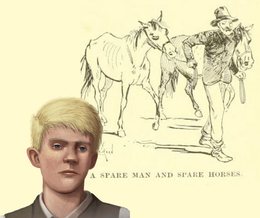
But Jemmy couldn't protect his mules from Union trickery. The night before the battle of Valverde, a Union spy named Paddy Graydon concocted a plan for killing the Confederate hoofstock using a couple of run-down mules as weapons. While his plan didn't work, he managed to spook the Confederate's pack mules. The animals, who'd been denied access to water for several days,  stampeded down to the Rio Grande, where Union soldiers rounded them up. Jemmy finds himself continuing to follow the army even though his reason for being with them is gone.

While Jemmy and his mules are fictional characters that I created for my novel, the story of Paddy Graydon is true. Graydon really did spook the Confederacy's pack mules, and the Union Army did really collect 
over 100 of the beasts when they broke to gain access to water. They lost over 100 animals and had to reconfigure their supply train. Before they left camp, the Confederates burned what they could no longer carry.  
In Hardtack and Coffee: The Unwritten Story of Army Life, Civil War veteran John D. Billings shares the story of another mule stampede. During the night of Oct. 28, 1863, Union General John White Geary and Confederate General James Longstreet were fighting at Wauhatchie, Tennessee. The din or battle unnerved about two hundred mules, who stampeded into a body of Rebels commanded by Wade Hampton. The rebels thought they were being attacked by cavalry and fell back.

To commemorate this incident, one Union soldier penned a poem based on Tennyson's Charge of the Light Brigade.
Charge of the mule brigade

Half a mile, half a mile,
Half a mile onward,
Right through the Georgia troops
Broke the two hundred.
“Forward the Mule Brigade!”
“Charge for the Rebs!” they neighed.
Straight for the Georgia troops
Broke the two hundred.

“Forward the Mule Brigade!”
Was there a mule dismayed?
Not when the long ears felt
All their ropes sundered.
Theirs not to make reply,
Theirs not to reason why,
Theirs but to make Rebs fly.
On! to the Georgia troops
Broke the two hundred.

Mules to the right of them,
Mules to the left of them,
Mules behind them
Pawed, neighed, and thundered.
Breaking their own confines,
Breaking through Longstreet's lines
Into the Georgia troops,
Stormed the two hundred.

Wild all their eyes did glare,
Whisked all their tails in air
Scattering the chivalry there,
While all the world wondered.
Not a mule back bestraddled,
Yet how they all skedaddled--
Fled every Georgian,
Unsabred, unsaddled,
Scattered and sundered!
How they were routed there
By the two hundred!

Mules to the right of them,
Mules to the left of them,
Mules behind them
Pawed, neighed, and thundered;
Followed by hoof and head
Full many a hero fled,
Fain in the last ditch dead,
Back from an ass's jaw
All that was left of them,--
Left by the two hundred.

When can their glory fade?
Oh, the wild charge they made!
All the world wondered.
Honor the charge they made!
Honor the Mule Brigade,
Long-eared two hundred!
The Stones River Battlefield Website stated that roughly half the horses and mules employed during the Civil War didn't survive. Jemmy Martin loses his to Paddy Graydon's plan. He spends the next two books in the Rebels Along the Rio Grande series trying to find them and return them to his home near San Antonio, Texas. 

Picture

Monday, July 18, 2022

There’s Gold in Them Thar Books!


Gold Rush Fever was an important part of America during the nineteenth century. The excitement and intrigue, the adventurous, desperate characters, and the challenges from other miners and from the elements of nature makes for awfully good reading for people of all ages. There is particularly good diggings for middle grade readers, ages 8-14.

The first American gold rush is one that few people remember. In 1799, a twelve-year-old boy named Conrad Reed found a 17-pound nugget of gold near his home in Cabarrus County, North Carolina. Not knowing what it was, the nugget was used as a doorstop until a jeweler recognized it and bought it. In 1802, word got out about the sale of that nugget and the Carolina gold rush was on.
A second gold rush began in Dahlonega, Georgia in 1829. The subsequent influx of miners and immigrants raised tensions with local Cherokee tribes, eventually leading to the forced removal of the tribes in what became known as the "Trail of Tears."

​The most famous gold rush in American history began on January 24, 1848, when gold was discovered at Sutter’s Mill in California. The surge ‘forty-niners,” people who immigrated to California hoping to strike it rich, caused California, which was not even a territory of the United States, to get on the fast-track to statehood. As in Georgia, Native Americans living near the goldfields were forcibly removed after clashing with miners.
Picture
The next gold rush occurred in the Pike's Peak Country of western Kansas Territory and southwestern Nebraska Territory, in what soon became Colorado. The Pike's Peak Gold Rush began in July 1858. The estimated 100,000 gold seekers who took part in this rush were known as "fifty-niners" after 1859, the peak year of the rush.  Their motto was “Pike's Peak or Bust!” even though the actual center of the mining activity was 85 miles north.

Cian Lachlann, one of the main characters in The Worst Enemy, book 2 in my Rebels Along the Rio Grande Trilogy (scheduled for release in 2023) is an orphaned Irish immigrant who becomes one the fifty-niners before joining the Colorado Volunteers and heading into New Mexico. The Book 1, Where Duty Calls, was published last month. It follows two boys through the Confederate invasion of New Mexico, up through the first battle.  

The last great gold rush of the nineteenth century was the Klondike Gold Rush. This rush began in in 1896 when local miners in Yukon, in north-western Canada found gold. When news reached Seattle and San Francisco the following year, thousands of prospectors, known as "Klondikers," flooded the ports of Dyea and Skagway in Southeast Alaska, trekked over the Chilkoot or White Pass trails, then floated down the Yukon River to reach the goldfields. By the time many had made this arduous journey, the land had all been claimed. As with other gold rushes, the indigenous people of the area suffered greatly as their lands were overrun with desperate and unscrupulous prospectors.
If you want to strike gold with a middle grade reader, I suggest you try one of these books: 

Picture
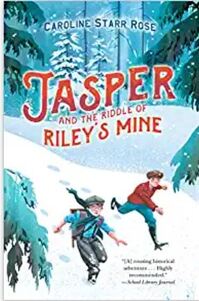
Jasper and the Riddle of Riley's Mine by Caroline Starr Rose
Eleven-year-old Jasper Johnson follows his older brother Melvin, who’s run away from their abusive, alcoholic father. The brothers leave the small town of Kirkland, Washington and take a steamer to Alaska to join the Klondike Gold Rush. While he is a stowaway onboard the ship, Jasper overhears men talking about One-Eyed Riley, a prospector who left clues in the form of riddles that will reveal the location of his still-rich stake. Jasper decides he must find Riley’s mine, but in addition to unraveling the clues, the brothers must cross harsh terrain despite increasingly bad weather and having few supplies. Add to this a host of unscrupulous and dangerous people who are also searching for the mine, and the odds against these two boys are almost insurmountable. Jasper’s pluck overcomes many obstacles, and, with the help of a few good people interspersed amid the bad, the brothers find something even more valuable than gold. Caroline Starr Rose does a great job of intermingling facts with a great story so that readers will learn a lot about the history and topography of the Klondike while never feeling lectured to. 

Picture
More books on the Klondike Gold Rush:


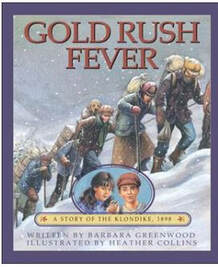
Gold Rush Fever: A Story of the Klondike, 1898 by Barbara Greenwood. 13-year-old Tim and his older brother, Roy, head off to the Klondike Gold Rush, where they face blinding snowstorms, raging rapids, backbreaking work and bitter disappointment. Each chapter in this book ends with facts, information, illustrations and photographs of the people and places of the time, and activities help bring the historical period to life.

Picture
Call of the Klondike: A True Gold Rush Adventure by David Meissner and Kim Richardson  Another story of two young men during the Klondike Gold Rush, this book uses first-hand diaries, letters, telegrams and news articles (written by Pearce) to tell the true story of Marshall Bond and Stanley Pearce, two college buddies who leave Seattle to search for gold. They meet Jack London, the author of Call of the Wild and White Fang, and had an adventure that reads as big as fiction, but is true.  

Picture
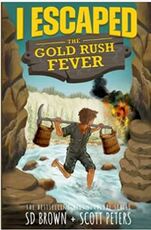
I Escaped The Gold Rush Fever: A California Gold Rush Survival Story by Scott Peters.  It’s 1852, and 14-year-old Hudson runs away from her domineering aunt in San Francisco to go in search of her father. She finds him along the Klamath River, where tempers among the California’s Gold Rush miners and the indigenous people are running high. When anger erupts into murder in an incident based on what is known as the Klamath River Conflict, Hudson finds herself trying to save herself and her wounded father.  This fast-paced book 11th in the I Escaped Series, is filled with action and sure to be a hit with fans of the I Survived Series, reluctant readers, and readers with short attention spans. A back section has facts about the California Gold Rush. 

Picture
More books about the California Gold Rush

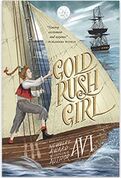
Gold Rush Girl, by Avi.  Victoria Blaisdell stows away on the ship so that she can accompany her father from Rhode Island to California as he searches for gold. When  her younger brother is kidnapped, Tory must search for him in Rotten Row, a part of San Francisco Bay crowded with hundreds of abandoned ships. 

Picture
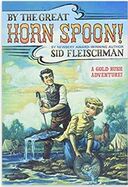
By the Great Horn Spoonby Sid Fleischman Twelve-year-old Jack goes to California in search of gold to help his aunt keep her home. His trusty butler, Praiseworthy, joins him on the adventure which will have readers laughing out loud!

Want even more books about American Gold Rushes for middle grade readers? Check out this list. 


Picture
Jennifer Bohnhoff is a retired middle school language arts and history teacher. She now stays home and writes, writes, writes, mostly historical fiction for middle grade readers. 

Jennifer is also an affiliate at Bookshop.org, an online bookseller  that gives 75% of its profits to independent bookstores, authors, and reviewers. As an affiliate, she receives a commission when people buy books by clicking through links on her blog. A matching commission goes to an independent bookseller. 
Please do not see her affiliation with Bookshop.org as a discouragement to shop directly at your local independent bookseller or to borrow from your local library. Everyone should support their public library and local booksellers as much as possible. .

Thursday, July 7, 2022

A HISTORY OF WINE IN NEW MEXICO


New Mexico has been making wine longer than any other state in the Union.
 
In 1598, Don Juan de Oñate led Spanish colonists to the upper valleys of the Rio Grande near Española, founding Santa Fe de Nuevo México. Accompanying him were Franciscan monks, charged with ministering to the Hispanos of New Mexico and spreading Christianity among the Native Americans. Central to their mission was providing daily mass, which included Holy Communion. According to the Catholic faith, the wine served during communion became, through transubstantiation, the blood of Christ shed for the redemptions of sinners.
 
The monks had a problem, however: wine was difficult to come by in New Mexico.  One quarter of Spain’s foreign trade revenue came from wine exports, and Spain was keen to protect this income source. A 1595 Spanish law forbade the export of Spanish grapevines and made it illegal to plant them in foreign soil. Instead of having a local source for their sacramental wines, monks in the colonies had to rely on wine that had crossed the Atlantic Ocean and been brought up the Camino Real, a journey that took several months at best and often over a year.
 
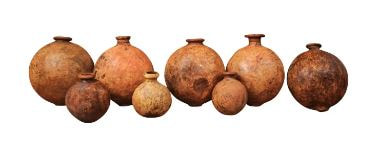
The wine shipped from Spain was light pink in color and tasted like sherry, with an alcohol content of 18%, and 10% sugar content. The heavy stoneware jugs it traveled in held between 2.6 and 3.6 gallons and resembled the jugs used in Roman times. The jugs had a green glaze that leached lead applied to their interiors.  Prolonged exposure to heat during the journey and the acidity of the wine exacerbated the leaching. 

Picture
Mexican wine jugs, 1830s
In 1629, a Franciscan monk named Fray Garcîa de Zuñiga and a Capuchin monk named Antonio de Arteaga decided that New Mexico had been deprived of their own wine long enough. They smuggled vines out of Spain and planted New Mexico’s first grapes in a field at the Piro Pueblo, just south of present-day Socorro. The cuttings they brought were from a variety of grape known as the Vitis vinifera, which is called the Mission grape today. It is still grown in New Mexico.
 
Soon, churches all over the region were planting and cultivating their own vineyards. By 1633, New Mexican viticulture was firmly established. But the relationship between Spanish settlers and Native Southwestern tribes deteriorated. In 1680, the Pueblo Revolt led to the expulsion of the Spanish settlers. During their twelve-year absence, many of their vineyards were destroyed. 

Picture
https://aces.nmsu.edu/ces/viticulture/history.html
When the Spanish returned, so did winemaking. Vineyards were planted along the Rio Grande from the northern border with Colorado all the way to the southern border near El Paso, Texas. Spain ceased to dictate policy when it lost control to Mexico. In 1853, New Mexico became a U.S. territory and it opened its borders to the east. The resulting influx of Americans brought significant changes to the land, and to the winemaking industry.
 
In 1868, Jean Baptiste Lamy, the first bishop of Santa Fe invited Jesuit priests to settle in Albuquerque and establish the Immaculate Conception Parish. Originally from Naples, Italy, the priests brought with them their own winemaking techniques, which they used when they founded their own winery. Other Italians followed, becoming merchants in Albuquerque’s booming downtown. New Mexico’s wine production increased nearly tenfold in the next ten years. By 1880, New Mexico had twice as much acreage in grapevines as New York and ranked fifth in the nation for wine production. By 1900, New Mexico was producing almost a million gallons of wine a year.

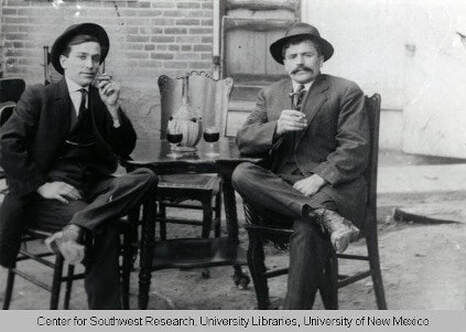
PictureOvidio and Ettore Franchini, proprietors of Franchini Brothers store, enjoying a glass of homemade Italian wine ca 1910. (Photo courtesy of Henrietta Berger, Center for Southwest Research, University Libraries, University of New Mexico, 2009-03-04

The 20th century didn’t begin well for New Mexico’s vineyards. In the 1920s, Prohibition limited wine production to small amounts for medicinal and sacramental purposes. Then a series of flood, including one in 1943 that was the largest flood in 100 years, destroyed the fields. Many thought that New Mexico would never again become a major producer of wine.

Once again, New Mexico’s wine industry bounced back. Beginning in the 1970s, small commercial wineries began operating in New Mexico. There were four in 1979. Two years later, Hervé Lescombes a winemaker from Burgundy, France came to try his luck in the desert. Many other European investors followed.  Today, more than 40 wineries and vineyards produce more than tens of thousands of gallons of wine annually in New Mexico, contributing millions of dollars to the state’s revenue.
 
Let us raise a glass to the tenacity of those who kept New Mexico’s wineries going, despite laws, rebellions, drought and flood. 


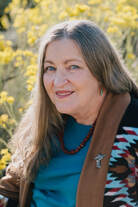
A former New Mexico history teacher, Jennifer Bohnhoff was born in the southern part of the state and has lived her entire adult life in New Mexico. She has written several historical fiction novels, some of which are set in New Mexico. Visit her blogsite for more information on her and her novels. 

Tuesday, June 28, 2022

Elegy for a Cantankerous Cat


History Lessons from a Walk in the Maine Woods

  I recently got back from a wonderful month in Maine. My husband and I rented a house right on a lake, and we spent a good portion of our t...